Big, Bad Booth?

I've been "running" the HUU booth at General Assembly, with an able assist from Jack Reich and each year, a rotating cast of enthusiastic others, since 2002.  I take some pride in the fact that we are usually among the largest and most energetic displays in the exhibit hall.  I take pride in the fact that we share our space with other humanist and social justice organizations - this year the Channing-Murray Campus Ministry, the Humanist Institute, Secular Student Alliance, and a Gun Control group called "Change the Conversation," were all on board.

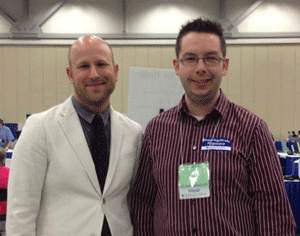
Greg Epstein of Harvard Humanists and Kevin Watson of The Humanist Institute

To me, our prominence among exhibitors reflects some of the best of UU humanism:  the fact that we believe enough in our values and programs to promote them with vigor; the fact that we are reminding our fellow religionists, gently, that UUism runs on humanist values, from the language of the Purposes and Principles, to the emphasis on individual conscience in religious matters, that is at the heart of many UU congregations, to our Association wide penchant for social justice action.  The  connections with other groups also speaks to me: the Humanist Institute is not only a major part of training the next generation of humanist leaders, it is also an incubator for educational materials for all those call humanism home; both the Secular Students and UU campus ministries are at the forefront of creating humanist communities for a new generation.


Jessica Kirsner of Secular Student Alliance
Two years ago the HUUmanists board began cautiously endorsing social justice projects, in response to the call for a Justice GA.  The focus on censorship in the Arizona Banned Books project appealed to a broad humanist consensus - even though it was clear that our national membership held divergent views on the policies in question.  The focus on literature and the right to read, and the creating of alternative libraries based on the infamous eighty Tucson volumes, in Phoenix, in El Paso and in Louisville, created a common front. The invitation issued to fabric artists, to add their vision with the "Ribbon" project, an effort in which emotion lead reason to some extent, was also adopted only after considerable reflection.  We didn't want to simply slap the organization's approval on something, and then regret it later.  

So when Janet Fisk (backed by a UU social justice staffer) asked this past spring if our June 2012 booth could host her "Changing the Conversation" program on Gun Control, I didn't know if we would have enough time for the kind of careful deliberation we had previously given such decisions.  I needn't have worried: Janet's reasoned approach of aiming to involve gun rights as well as gun control advocates in the same broad ranging conversation, and her use of the arts (she is a documentary film maker) an area of social action with which we had become familiar, was a combination that carried the day.  Sensing the social urgncy of the issue, and the need for a variety of activist approaches under our HUU rubric of "reason and compassion," our board said: "if there is any other issue we should be adding to our agenda this year, this is it."


Janet Fisk, filmmaker

Janet's films and fliers joined a booth already adorned with the two dozen "Ribbons Not Walls" art pieces, and 160 copies (two full sets) of the Banned Books, headed to the library of the Americana Center, which serves 17 immigrant groups in Louisville.  

Arguably, the biggest, baddest thing at the booth this year was the sizable contingent of HUU Board members and regional volunteers who helped staff it.  They engaged folks who came by (I estimate about 2,500 of the 3,500 or so GA attendees visited our location) answered questions, handed out literature, sold books, stickers, pins, memberships and sponsorships for our social justice programs. Others have done the same in years  past, but in much smaller numbers.  Combined with our increasingly productive board meetings, livelier web presence and growing publication and social justice profile, this years HUU booth effort gives me great hope.

Come see us in Providence - June 2014.

Roger Brewin, booth coordinator Read more about Big, Bad Booth? »

Categories: 

Ribbons on the Road

A collection of two dozen fabric arts panels made by humanist and UU artists around the country, began its fall tour during the last weekend of September, with a showing at a Michigan community event and a UU Fellowship Sunday service.  "Ribbons Not Walls" (a project of HUUmanists) invites people to create yard long representations of immigration related events and themes.  The collection includes a starkly poetic rendering of a portion of the "wall" between the US and Mexico by 13 year old Illinois UU Alayna Vesto, two panels featuring the primitive quilting style of Linda Lee, lead artist of the well known Farmworkers Memorial quilt out of Florida, and the HUUmanists "Librotraficante" (Book SmUUggler) Iogo, stitched and be-ribboned by Michigan secular humanist Sherron Collins.  

"Ribbons" began as an outgrowth of the Banned Books project run by HUUmanists for the 2012 UU General Assembly in Phoenix (the "Justice GA."). Initially artists depicted themes from some of the 80 books, mostly by Hispanic authors, that were removed from Tucson classrooms when Arizona lawmakers voted to end "Ethnic Studies" in that state's schools. (See RibbonsNotWalls.org or the facebook page ribbonsnotwalls for more information on the Banned Books project.)   Gradually the art project widened to include impressions from congregational events about immigrant rights and culture, and then to individual and group reflections on the impact of the issue on our society. 

As panels came in through the spring of 2012, they were put on display singly and in small groups at more than a dozen humanist meetings, UU congregation and district conferences. The first full installation of all the panels was at the HUUmanists booth (see "Big, Bad Booth" article elsewhere in this issue) at the June 2012 GA in Louisville, where it was seen by over two thousand attendees.  Subsequently the minister and members of Berrien UU Fellowship in St. Joseph, MI arranged for the full collection to be on display September 28 at the Berrien County Unity Fest, an annual political event held this year in a huge 19th century barn.  The Ribbon panels were stretched from the rafters, above the heads of 150 diners and dancers. The next morning at BUUF's Sunday morning service, led by Roger Brewin, self-styled "curator" of the project, the panels were held aoft by congregants, then formed a visual backdrop for the post service discussion.

The next stop for the Ribbons tour will be Northern Hills UU Fellowship just outside Cincinnati, with a service by Brewin on the morning of October 27, followed by a public showing throughout the afternoon.  UU ministers in the Ohio River (study) Group will get a look at the panels (and a chance to contribute to the collection) on Wednesday evening November 13 in Dayton, Ohio.  Further showings at art galleries and on seminary campuses are being negotiated.  Humanist groups and UU congregations that would like like to host the art work in 2014 are invited to contact Brewin at Rabrewin@aol.com,  773 881 4028 or 773 551 8540.

"Ribbons began as a way to let artists shine a different spotlight on the issue of censorship, and the right of every culture to define itself without interference," says Brewin - "these are aspects of the broader immigration question that appeal particularly to humanists.  The Ribbons art does not demand that you take a particular political stance on immigration, or that you follow a particular set of actions.  It does demand that you encounter the people and communities involved, through the honest filter of your own emotional reactions and rational convictions. The art both brings you closer to people, and gives you a medium through which to put aside reactivity, and encounter their humanity.  As a humanist, I have "faith" that that sort of encounter can change things."  Read more about Ribbons on the Road »

Categories: 

Ethical Dilemmas and Humanist Ethics

Michael Werner gave an excellent talk at the Concord Area Humanists meeting on October 23, 2013 about Humanist Ethics. Mike and his wife Susanne were in the area as part of Mike's book tour to promote his new book "Regaining Balance: The Evolution of the UUA". Here is the video of Mike's talk. (If the video does not appear below, try this link.)

And here are the slides:

Read more about Ethical Dilemmas and Humanist Ethics »

Categories: 

"You Are Theist, I Am Humanist"

Here's to the goal of not taking ourselves too seriously!

Sung by J.T. Bakes & Max Gibson

Lyrics

You are theist I am humanist
I think that you're naive
You have no proof to offer as truth,
You simply say "I believe"

New age bubbles get you in trouble
Lost in a feel-good fluff
True understanding is quite demanding
Praying is not enough.

Totally unprepared are you
To make a case that's plain
Maybe the incense, chants, and drums
Have ruined your poor brain.

You need someone older and wiser
Telling you what to do,
You are theist, I am humanist
I--will think--for you!

I am theist, you are humanist
You're locked inside your head.
You're existential, self-referential
Claiming that God is dead,

Occam's razor, Pascal's wager
Soul-less tautology
Wisdom, traditions, not erudition
Make much more sense to me.

Totally unprepared are you
To let go of your mind.
How 'bout a leap of faith, my friend
You might like what you find.

When you find that you're out of answers
You won't know what to do
I am theist, you are humanist,
I -- will pray -- for you.

We cannot agree on anything
Each has a point of view,
I am theist --- I am humanist
That's why we're UU.

by Meg and Scott Bassinson of Albany, New York. Read more about "You Are Theist, I Am Humanist" »

Categories: 

Mike Werner's New England Book Tour

Michael Werner is going to be touring the New England area in October, speaking about his new book "Regaining Balance: The Evolution of the UUA". If you are in the area you can see Mike speak at the following events:

Categories: 

Religious Humanism Comes of Age

[Editor's note: This text was first presented as a sermon at the Unitarian Universalist Society of Amherst, MA, 10/21/12. An shortened version of it appeared in the Fall 2012 issue of the journal, Religious Humanism.]

When I was a child, I spoke as a child, I understood as a child, I thought as a child: but when I became a man, I put away childish things. (I Corinthians 13:11)

I’ve come to realize that this simple description of the necessary transition from childhood to adulthood applies not just to individuals but also to cultures and societies, and ultimately to the human species itself.

We human beings are a very young species.  From an evolutionary perspective we are barely out of adolescence.  And it shows!  Around the world today there are some people within virtually every religious tradition desperately clinging - sometimes violently - to the tribal deities and exclusionary beliefs of their ancestors.  It’s as if they are standing there, stomping their feet and shouting, “I won’t grow up, I won’t grow up!”  We have a kind of global Peter Pan Syndrome on our hands.

Human coming of age – as individuals, as communities, and as a species – is a major focus of today’s Humanism, especially religious Humanism.  Today I’d like to lay out a little bit of the history of Humanism within Unitarian Universalism, identify some of the challenges that face us in a rapidly changing world, and finish with some suggestions on what role UU Humanists can play in turning those challenges into opportunities.

But before I get into that, let me tell you briefly about my own continuing attempts to grow up and how they led to my standing here before you today.

I was raised in eastern Massachusetts as an Episcopalian.

I still own the 1940 edition of The Hymnal of the Protestant Episcopal Church of the United States of America.  Here’s what’s inscribed on the flyleaf of my copy:

First Prize

“Name That Hymn” Contest

St. Paul’s Junior Young People’s Fellowship

November 7, 19… (Well, you don’t have to know the exact year.)

Won by John B. Hooper

This is still one of my most cherished possessions.

I was drawn to the resonance of the Anglican music and to the community experience of liturgical ritual.  So, I went on to sing in the choir and then to become an acolyte.  After years of dedicated service, I was appointed head acolyte in my late teens.  In the meantime, I had made up my mind to become an Episcopal priest.  But then something happened that abruptly changed the course of my life.  I call it my inverse epiphany experience.

One Sunday, after doing my head acolyte thing of carrying the cross at the front of the procession of priests, other acolytes and the choir into the church and up to the chancel, I settled in for yet another service.  Of course, by then, I knew the entire liturgy pretty much by heart, so I was free to observe the faces and body language of folks in the congregation.  While I was watching the faithful filing up to the altar rail to receive communion, it struck me:  Many of them looked like automatons.  There was no passion in their faces – no emotion.  And I thought to myself: This is nonsense!  I didn’t only know it in my mind; I felt it at the core of my being.  It was a life changing experience.  Like being “born again” in a weird sort of way.

But, I loved the freedom that casting off all supernatural crutches gave me.  I began carrying pocket editions of the writings of Bertrand Russell and Friedrich Nietzsche around with me, and quoting from them to almost anyone who would listen.  I had the same level of enthusiasm for my newfound atheism as today’s young freethinkers, who relish the writings of Dawkins, Dennett, Harris, and Hitchens – the so-called “Four Horsemen of New Atheism.”  I was a committed atheist and existentialist long before I became a Unitarian Universalist.

Of course this change of circumstances put a significant damper on my priestly ambitions.  Now what would I do with my life?  Well, since math and science seemed to come naturally to me, I went on to college and graduate school, studied chemistry, and became a scientist – almost by default. 

I had put away the religion of my childhood and become a NONE – that’s spelled N-O-N-E – the term that is now used to refer to that ever-growing class of people who say they have no religious affiliation.  NONEs have gotten an awful lot of attention recently.  The Pew Forum on Religion and Public Life has conducted a series of surveys; including one published a short time ago, on the religious affiliations of Americans.  The results present both a challenge and an opportunity for Unitarian Universalism.  Here are a few excerpts from the survey results:

One fifth of the U.S. public – and a third of adults under 30 – are religiously unaffiliated today. …

The growth in the number of religiously unaffiliated Americans – sometimes called the rise of the “nones” – is largely driven by generational replacement, the gradual supplanting of older generations by newer ones. A third of adults under 30 have no religious affiliation, compared with just one ­in­ ten who are 65 and older.

The ranks of the mainline denominations become more and more depleted every year.  The challenge for Unitarian Universalism is to be not perceived as just another organized religion.   If we are, our numbers may not just stay level, they will probably drop precipitously.  Younger people in particular are looking for new ways to come together in community outside of the traditional “religious” model.  And this is where our opportunity lies.  We have not been and are not now a traditional religion.

Like many others when I finally found Unitarian Universalism after wandering around in Noneville for 25 years, it felt like coming home.  Three things in particular drew me to this way of life: First, Unitarian Universalism is a religion of freedom and responsibility, not creeds – one could actually be an atheist or an agnostic and still be a UU!  Second, it is concerned with life before death, not in any postulated “hereafter” – the seven principles are about action, not belief; and, third, it’s all about reason and compassion.   

In short, I was drawn by what I now know is the Humanistic core of Unitarian Universalism.  And I firmly believe that if it is presented in the right form – most likely outside of the traditional congregational assembly - it will appeal to a large fraction of today’s young NONEs.

The term religious “Humanism” was actually coined by Unitarians.  Around the time of WWI, two Unitarian ministers began to preach and teach a religion without God.  One of them, Curtis Reese, called it “a religion of democracy.” The other, John Dietrich called it “Humanism.”  During the 1920’s, divinity students at the University of Chicago and its Unitarian affiliate, Meadville Theological School embraced this new “American religious Humanism,” which was defined in the Humanist Manifesto in 1933.  Half of the 34 signers of the Humanist Manifesto were Unitarian ministers.  Religious Humanism (as depicted by the Manifesto) combined the worldview of scientific naturalism with the compassionate ethics of a world community of free and equal human beings, with no mention of supernatural entities, miracles, or individual life after death.

The Humanist tradition is now carried on by the HUUmanists Association, which I am privileged to lead.  To learn more about us and the many initiatives we have underway, go to our website at HUUmanists.org.  We have recently published a new book by Rev. Bill Murry, called “Becoming More Fully Human: Religious Humanism as a Way of Life.”  It’s become a kind of handbook for religious Humanists.  You can purchase it on our website.  We also publish the Journal Religious Humanism.

So, with that little bit of history behind us, you might be wondering: where are we today?  How would I recognize a Unitarian Universalist Humanist if I saw one?  (Well, whether you’re wondering or not, I’m about to tell you.)

We UU Humanists have adopted a naturalist perspective as a predominant part of our life stance, a commitment to the evolutionary view of life and its origins.  We are just as “secular” as secular Humanists in the traditional sense of being “this-worldly.”  We believe that humans are responsible for addressing both the human condition and the ecological challenges we humans have been largely responsible for creating.  Unlike the so-called “new atheists” we don’t lead off with non-belief.  Rather, we take pretty much the same position as the great French mathematician and scientist, Pierre Simone LaPlace.  When Napoleon asked him why he made no mention of God in his scientific writings.  LaPlace replied, “I have no need of that hypothesis.”  If one of us happens to be an atheist, and many of us are, it is probably more a consequence of her Humanism than a cause of it.

Many UU Humanists are concerned that the increasing use of God language in some UU worship services undermines our message and may actually turn off many non-affiliated visitors, who otherwise might be attracted to Unitarian Universalism.  Some of my Humanist colleagues think that Unitarian Universalism is going to heaven in hand basket.  I share that concern, but I think we UUs are still the best game in town for people who are looking for authenticity, acceptance, and love in a dogma-free religious community.  Since I spend a lot of time in atheist and secular Humanist circles, I’m often asked why I remain so closely associated with other UUs who don’t have the same position that I do on the “God thing.”  I always reply, “because I love them and they love me.”

Which brings me to another important attribute of modern day religious Humanists, which might be surprising to some who may have bought into the stereotype of the typical Humanist as a hyper-rational white male scientist or philosopher.  We are in actuality a very diverse bunch, who are no longer reluctant to appeal to the emotions as a complement to reason.  We have compassion for others and celebrate the shared experience of being alive.

What’s this “appeal to the emotions” bit?  Have the hardheaded Humanists gone soft on scientific objectivity?  Not at all.  In fact, it is our respect for science that prompts us to value lived experience tempered with reason.   Over the the past few decades, there have been enormous advances in what may be called “the sciences of experience.”  We now know that we are essentially hard-wired for empathy and compassion.  Our brains did not evolve to enable us to think, but rather to help us make our way in the world.  Cognitive scientists have show that emotions and feelings are not epiphenomenal to thought, but an important component in the process by which we make our way in the world.  They are central to our rationality and, as the neuroscientist Antonio Damasio observes, are “a powerful manifestation of drives and instincts, part and parcel of their workings.”

Mary Oliver also has something to say about this.  I don’t know if she would consider herself a Humanist, but I think she summarizes the religious Humanist perspective beautifully in her poem “Wild Geese:”

You do not have to be good. 
You do not have to walk on your knees 
for a hundred miles through the desert, repenting. 
You only have to let the soft animal of your body 
love what it loves. 
Tell me about despair, yours, and I will tell you mine. 
Meanwhile the world goes on. 
Meanwhile the sun and the clear pebbles of the rain 
are moving across the landscapes, 
over the prairies and the deep trees, 
the mountains and the rivers. 
Meanwhile the wild geese, high in the clean blue air, 
are heading home again. 
Whoever you are, no matter how lonely, 
the world offers itself to your imagination, 
calls to you like the wild geese, harsh and exciting--
over and over announcing your place 
in the family of things.

We Unitarian Universalists take pride in the fact that we come from a long line of heretics.  A heretic is usually thought of as a person who holds beliefs or ideas that are contrary to those of her or his religious tradition.  But the word “heresy” actually comes from the Greek hairetikós, which means “able to choose.” In ancient days it also referred to a process used by young people examining various philosophies to figure out how they would live their lives. 

I am convinced that religious Humanism is the Grand Heresy of our times – in both senses of the word - and not only in Unitarian Universalism.  Modern Humanist heretics are emerging from within virtually all of the world’s religious traditions.  People are putting away the childish superstitions of their faiths, but retaining the traditions, the commitment to social justice, the culture, the caring for each other and the sense of community that they have grown to cherish.   Let me give you a couple of examples from other traditions:

First, from Judaism.  Here’s a portion of the philosophy of the Society for Humanistic Judaism:

Theistic religions assert that the ultimate source of wisdom and of the power of the solution to human problems is found outside of people - in a supernatural realm. Humanistic philosophy affirms that knowledge and power come from people and from the nature in which they live. Judaism is an ethnic culture. It did not fall from heaven. It was not invented by a divine spokesperson. The Jewish people created it. It was molded by Jewish experience.

Here’s an example from Christianity: Chet Raymo, a prolific writer and astronomy professor at Stonehill College (a Catholic institution) has written about his conversion from the dogmatic Catholicism of his early years to his growing commitment to a kind of Humanistic religious naturalism.  This is what he says about it in his book “When God is Gone, Everything is Holy:”

The divinity of the conventional theist is not so much seen through a glass darkly as in a mirror brightly.  And what could be more natural?  What metaphor is closer at hand than our own self-awareness?  Pre-scientific people invested every tree, brook, and celestial body with personhood.  For all its grandeur and refinement, the modern idea of a transcendent, personal deity who acts willfully in the world is only the final manifestation of ancient animism.  For the religious agnostic, this is the ultimate idolatry,

Here’s an example from Buddhism: Stephen Batchelor, in his book Confession of a Buddhist Atheist, points out that the Buddha was not a theist nor was he an anti-theist.  The word “God” was simply not a part of his vocabulary.  Batchelor is championing a new Westernized version of Buddhism that has jettisoned all supernatural accouterments.  For example, he observes, “the practice of mindfulness aims for a still and lucid engagement with the open field of contingent events in which one’s life is embedded.” For him, Buddhism is a religion of engagement not belief. 

These examples, and many others I haven’t mentioned, bring to mind the Rumi poem often quoted in UU services.  Incidentally, I think that the Sufi poet Jalal al-Din Muhammad Rumi was one of the very early religious Humanists coming out of Islam.

Out beyond ideas of wrongdoing and right doing
There is a field
I’ll meet you there.
When the soul lies down in that grass
The world is too full to talk about.
Ideas, language, even the phrase ‘each other’
Doesn’t make any sense.

People from a wide variety of religious traditions are casting off the gods and superstitions of the past and moving towards Rumi’s field “out beyond ideas of wrongdoing and right doing.”  They are looking for ways to express this new naturalist religious experience that they share. If Unitarian Universalism is to really become the religion for our times we must provide relevant opportunities for these searchers.  If we do I think we will also become more attractive to all those “NONEs” out there needing a religious home.

To me, one of the most exciting recent developments in American Humanism is that atheists and secular Humanists are realizing that heading towards Rumi’s Field might be a good idea for them as well.  My friend, Greg Epstein, the Humanist chaplain at Harvard puts it this way in his recent book “Good without God:”

(T)he single biggest weakness of modern, organized atheism and Humanism … has been the movement’s own tendency to focus on religious beliefs, when the key to understanding religion lies not in belief at all but in practice – in what people do, not just what they think. … (N)ow we need to sing and to build.  We need to acknowledge that as nonreligious people, we may not need God or miracles, but we are human and we do need the experiential things – the heart – that religion provides: some form of ritual, culture, and community.

Greg is practicing what he preaches.  He started the Humanist Community Project at Harvard, which is flourishing.  I visited them last week and when I walked in, it felt a lot like it does when I walk into a Unitarian Universalist Community.

As Greg observed, Humanism is not just a philosophy, it’s a way of life that is defined by the way we treat each other.  Here’s a little story that I found on one of the many Humanist blogs.  I think it illustrates the kind of humanist perspective we need to foster in our every day interactions.

Imagine this:

You are driving down the road in your very tiny "Smart Car" on a wild, stormy night, when you pass by a bus stop and you see three people waiting for the bus:
1. An old woman who looks very very ill.
2. An old friend who once saved your life.
3. The perfect partner you have been dreaming about.
What would you do, knowing that there could only be one passenger in your car?

This is a moral/ethical dilemma that was once actually used as part of an employment application process. This problem was presented to 200 job applicants. The candidate who was ultimately hired had no trouble coming up with his response.  He simply answered: “I would give the car keys to my friend and ask him to take the old woman to the hospital.  I would then stay behind and wait for the bus with the partner of my dreams.”

Let me close with this.  I am confident that the grand heresy of religious Humanism will eventually sweep through the great religious traditions of the world.  I am equally confident that many more atheists and agnostics will recognize that their human need for love, acceptance, and shared experience can only occur in an assembly of like-minded, warm-hearted people.    Religious Humanists are casting off the supernatural baggage of their religious traditions, which the secular Humanists never had in the first place.  At the same time, secular Humanists are acquiring the experiential communitarian elements that we religious Humanists already have.  We are all really heading for the same place – the place I’ve called Rumi’s Field. 

Unitarian Universalists have a special role in this emerging Humanist convergence.  Remember that the American form of the Grand Heresy began almost a century ago within our own religious tradition.  And it blossomed back then by capturing the imagination of a group of freethinking students.  I believe that, like our forebears, we Unitarian Universalists have a special role to play with the freethinking young people of today.  We must accept them where they are in their life journeys.  Our congregations need to be more openly welcoming to atheists and agnostics.  Young nonbelievers of today shouldn’t have to wait twenty-five years to “come home” to Unitarian Universalism like I did - or perhaps never get here.  This congregation nestled as it is in the five-college area has a unique opportunity to show nonbelieving young people that our “faith” doesn’t take away from their nontheistic life stance.  Rather it adds love, purpose, and community to it.  Go for it!

Knowing that we are a young species just coming of age, our religious quest must be to become more fully human, while continually striving to understand what being fully human really means.  If we strive to carry out the Humanistic vision of our forbears, we may actually help ourselves, our country and our species to grow up.  Read more about Religious Humanism Comes of Age »
Categories: 

Celebrating David E. Schafer, President Emeritus

One of the pleasures I had at the HUUmanists' yearly meeting a the 2013 UUA General Assembly was naming David Schafer our President Emeritus. David has been a friend and mentor for many years and I am personally grateful for all he has given the HUUmanists Assocation, including the years he spent as president from 2003 - 2010 and his on-going service on our Board.


Here is a David's abbreviated biography:

David Schafer is a retired physiologist living in Hamden, CT with his wife June.  Pre-Humanist phase:  Raised fundamentalist Christian.  In adolescence immersed in the major religions, texts in original languages.  Other supporting skills: mathematics, music.  1948 B.A., English major, history minor; to graduate school, Univ Minnesota, English 1948-51 TA, Robert Penn Warren, Interp. Poetry; also medieval English, Classics, philosophy esp. of science. 1951 major shift to sciences (TA physiology; adv. physics/mathematics/chemistry) and Humanism (at Minneapolis First Unitarian Society: music committee chair, composer, pianist).  1957 instructor of physiology; 1959 Ph.D.  1958-1963 NY Univ, physiology, instructor to assistant professor (also translator/editor, complete translations, two Russian physiology journals).   Asia: 1963-66 (Fulbright) Prof., Physiol. and Biophysics, Calcutta Univ, India, concurrent appointmt to conduct basic cholera research, the Johns Hopkins Center for Medical Research and Training.  1966-68 to Rockefeller Foundation (RF), Bangkok, Thailand, as acting physiology chair, new medical school, Mahidol University.  RF also supported two years cholera resch and six Bengali PG students as TAs.  Also in India and Thailand, adv. study in Hinduism and Buddhism.  USA: 1968-99 US Veterans Administration (VA), PI, cholera resch; teaching; admin first, 1968-74, in Minneapolis and 1974- , then to W Haven (CT) VA/Yale University.  1977 Acting Assoc. Chief of Staff for Research, W Haven (CT) VA (one year).  Co-founded Humanist Assn. of CT; president 1989-99.  Humanist Institute: graduated 4th class; board member (2000- ); co-mentor 9th  class.  1999 retired VA.  Board member: Amer. Humanist Assn. (1999-2001); ACLU-CT (1999-2009); Unitarian Universalist Humanists (HUUmanists) (1998- ), president, 2003-10.  Currently consulting editor, The Humanist.  Publications and lectures: 50+ articles, uncounted lectures on research and many other topics, from Islam to Humanism.  Read more about Celebrating David E. Schafer, President Emeritus »

Categories: 

"Why I Am a UU Humanist", by Mehl Renner

Editor's note: this is an entry in a series of essays on this topic. Please, share your story.

FREEDOM DEPENDS ON FREETHINKERS!

My title likely comes from a bumper sticker and I borrow it because I have such a strong belief in the concept of freedom. That certainly includes the freedom to be an atheist! I am Vietnam veteran and did not serve my country so I would be required to believe in God. We are NOT a country “Under God”, but rather under a constitution that gives us the freedom to believe or not believe as we choose. The best thing to have faith in is yourself!

My mother raised my two sisters and me as a Baptist to expose us properly to being churched in the South. My dad was in the beer business and that was rather frowned upon. He was once the Plant Manager of the Budweiser Brewery in St. Louis. I think he was always a hard core atheist and I later embraced that as well. I believe it began to happen for me when I entered college, because it was then that I really started doing more genuine thinking. In later years my dad and I both loved the thinking of Sam Harris and Richard Dawkins and all the principles of Humanism. We had no regard for most religions, but were both approached to become charter members of a Unitarian Universalist church. Most of the charter members were gay and were turned away by local churches. That was just not right. I liked the idea of seeking truth on your own terms and in my mind constantly redefining by reason my spiritual equation to live by. So about 20 years ago my dad and I became charter members of the Georgia Mountains UU Church located in Dahlonega, GA. We both were featured speakers at services and really tried to convey the need for more of a “habitat of humanism” rather than a “house of worship”. To worship anything is to enslave the mind.

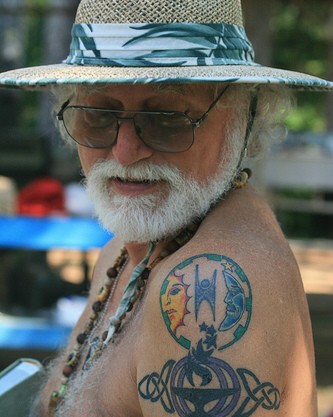
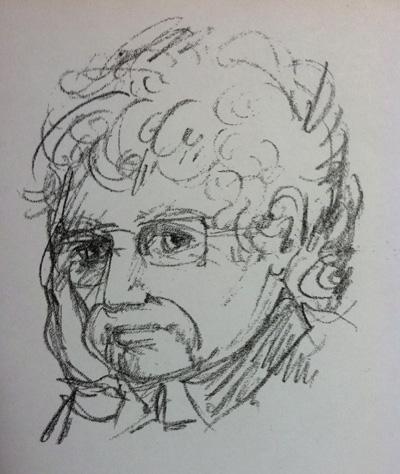
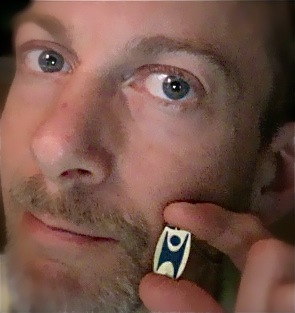
Fourteen years ago I moved to Charlotte and became a member of the Piedmont UU Church. There I met my significant other, Gail, at a church coffee house event. [Editor's note: that's Gail's portrait of Mehl on the right. The one above was taken at the Burning Man Festival.] She is a woman who claims to be a druid, with a similar distaste for fundamental Christian belief. She tends to be more spiritual and that is okay. There is book written by a highly respected French author titled “The Little Book of Atheist Spirituality”. A humanistic perspective is that God is within us and not a super natural power over and above us. In other words, we are God. We need to be far more concerned about our planet in order to be one with the earth. Similar to the message conveyed in the pantheistic message of the movie “Avatar”. I mention the UU church I am a member of here in Charlotte because a couple of years ago I was nominated and became president of this congregation in spite of my well known standing as an atheist. This says a lot about the tolerance of that denomination and demonstrates how members truly have the freedom to seek what is truth for them without being subjected to the traditional dogma for most churches.
I am extremely proud to be a freethinker and free to be an atheist!

Mehl W. Renner – Charlotte, North Carolina

  Read more about "Why I Am a UU Humanist", by Mehl Renner »

"Why I Am a UU Humanist", by Brian Lofgren

Editor's note: this is the first in a series of essays on this topic. Please, share your story.

Why I Am a UU Humanist

In my case, it took thirty-nine years to arrive as a Unitarian Universalist (UU) Humanist. I’m writing this essay just nine years beyond that memorable crossroad. I was raised in Christian culture. Like my Methodist parents and grandparents, I was conditioned from childhood to suspend critical thinking where religion was concerned, and just believe. This message was reinforced in the Lutheran school I attended from fourth, through eighth grade.

The popular God, the “Everything-God”, was the 'face' that personified not only the known, but the vast unknown. Religious systems may help followers meet some of their emotional, psychological, and social needs. However, readily accepting mythical-sounding stories as fact came at a cost.

I returned from South America in 2003, after five years as a Catholic “missioner”. I was in the throws of a cultural and religious transition that would last at least four more years. Furthermore, my wife and I had considerably downsized our economic footprint; we were starting over.

The five years of social justice work had brought me up to speed on the workings of Patriarchy, Hierarchy, systemic injustice, and the need for social, and environmental responsibility. During those reflective years, I had reevaluated my Methodist and Lutheran upbringing, my adopted Catholicism, and many other traditional, religious systems. Through a journey of book research and timely conversations, I slowly transitioned to a broader, more natural world view.

Soon after gaining easy, stateside access to the Internet, I stumbled across the religious debates and books of Christopher Hitchens, Sam Harris, and Richard Dawkins. The candor of their presentations, and the pointedness of their factual evidence ruptured my remaining bubble of contextual ignorance. In the aftershocks, I went through a period of emotional turbulence, and a sense of alarmed urgency.

Some friends and family members graciously responded to my long, sometimes agitated email conversations regarding various aspects of opposing world views. During that difficult transition period, I poured my thoughts into one of my web pages titled, “Toward Secular, Religious Harmony”. I’ll probably place a copy of this essay there, among my earlier musings.

After receiving a graduate degree in May of 2006, I was introduced to The Virtues Project. I had some poignant conversations with the projects’ founders and two of its instructors. I created over sixty illustrations for the Project, portraying examples of socially responsible behavior. I latched onto this idea of universal, healthy behavior. I was looking to bridge the gap between my past and present sense of self. I wished to connect with people dear to me on either side of the personal chasm I had crossed. Ethical virtues, and the UU Principles symbolized common ground. These were ideas I could embrace. I didn’t want to be fooled again.

Throughout the summer and autumn of 2007, I worked compulsively, meticulously, to write, illustrate, and design a twenty-seven page booklet titled, Guide From Inside. I had nobly (idealistically) decided that this was to be a legacy, a lasting contribution. It incorporated playful sketches, memorable rhymes, and thoughtful reflection questions that explored the benefits of cooperation, courage, creativity, enthusiasm, fairness, forgiveness, kindness, moderation, peacefulness, respect, thankfulness, and truthfulness. I printed a box of books, and placed an e-book on line. Knowing little of marketing techniques, and having accomplished my task, I soon “called it a day” on my book project, and moved on. I’ll share a page now and then with one of my children, when a teachable moment presents itself.

2007 was also the year that I joined the Unitarian Universalists of Cedar Lane, Maryland. I chose Unitarian Universalism as a place to land in 2003, and they haven’t let me down yet. I’m also fond of Ethical Culture, and hope to visit those communities from time to time. My wife and our three children have joined me at Cedar Lane UU, and we are becoming more involved there each year. As the product designer of the official, UU Humanist, online store, I’m inspired to help promote a natural world view, especially where government policy is concerned. I’m also becoming endeared to the chalice symbol, and it’s history.

Religious stories are, arguably, inspired and imaginative, but current understanding has outgrown supernatural beliefs, and magical explanations. I no longer assume to know (through tradition, authority, or claims of revelation) more than current understanding supports. The 2012 Reason Rally in Washington, DC was an exciting show of support for the secular, and progressive religious movements. They are quickly gaining momentum in this age of informational access and social media.

I hope to retain the feeling of wonder I experienced in my youth. I’m seeing life with fresh eyes through my children, and through the amazing discoveries and images presented almost daily by scientists. Having shaken off the coils of religious Dogma and static Creed, our family has begun to form its own traditions.

I find it freeing to help create and take part in meaningful celebrations such as HumanLight, and Chalica. I’ve created a web page that shares that experience as well. The growing list of Humanistic celebrations, of course, includes Darwin Day and Earth Day. I would like our family traditions to be enjoyable, meaningful, educational, and to reflect reason, compassion, social responsibility, and a natural world view. I would like to see our Humanistic traditions evolve with us, as we grow and learn. Read more about "Why I Am a UU Humanist", by Brian Lofgren »

Pages

Subscribe to Front page feed