The Clergy Letter Project: Demonstrating the Compatibility of Religion and Science

There’s an all-too common view in the United States that religion and science are in conflict.  While this conflict takes many forms, none is more prevalent than that associated with the evolution/creation debate.  Simply put, there are some who proclaim loudly and often that one can’t be truly religious if evolution is accepted.  The basic premise of this position is that people must choose between their religion and modern science; that it is impossible to embrace both.

In fact, however, despite the volume of these claims, this position is very much at odds with what a huge majority of devout individuals understand.  In an attempt to share this message as broadly as possible, I created a grassroots organization that has grown to more than 15,000 clergy members.  This organization, The Clergy Letter Project, has three clear and simple goals:

  • To demonstrate that religion and evolutionary biology are compatible;
  • To demonstrate that Fundamentalist ministers who demand that people choose between religion and modern science are not speaking for all religious leaders; and
  • To raise the quality of the discourse on this important topic.

The Clergy Letter Project began over ten years ago by collecting signatures from Christian clergy members on a two paragraph letter urging that evolution be taught in public school science classrooms and laboratories.  The Letter became quite popular and Christian clergy members all across the United States flocked to sign it.  To date, it has amassed 12,990 signatures.

The UU Clergy Letter

Immediately upon its release, I began to hear from Unitarian Universalist ministers.  While some were willing to sign The Clergy Letter, others expressed discomfort doing so because of its explicitly Christian focus.  Many of those who contacted me urged me to develop a similar letter specifically for UU clergy.  In response to this call, a number of UU clergy did just that and The UU Clergy Letter was born and it has now been signed by 284 UU clergy members. 

The UU Clergy Letter notes, “While most Unitarian Universalists believe that many sacred scriptures convey timeless truths about humans and our relationship to the sacred, we stand in solidarity with our Christian and Jewish brothers and sisters who do not read the Bible literally, as they would a science textbook. We believe that religious truth is of a different order from scientific truth. Its purpose is not to convey scientific information but to transform hearts.” 

The Letter concludes, in much the same manner as The Christian Clergy Letter, by proclaiming, “We the undersigned, Unitarian Universalist clergy, believe that the timeless truths of the Bible and other scriptures may comfortably coexist with the discoveries of modern science. We believe that the theory of evolution is a foundational scientific truth, one that has stood up to rigorous scrutiny and upon which much of human knowledge and achievement rests. To reject this truth or to treat it as "one theory among others" is to deliberately embrace scientific ignorance and transmit such ignorance to our children. We urge school board members to preserve the integrity of the science curriculum by affirming the teaching of the theory of evolution as a core component of human knowledge. We ask that science remain science and that religion remain religion, two very different, but complementary, forms of truth.”

The UU Clergy Letter thus stands with The Christian Clergy Letter, The Rabbi Letter and The Buddhist Clergy Letter and serves to make it clear that a choice does not have to be made between deeply held faith and the best modern science has to offer.

Evolution Weekend 

Clergy from all of these religions have recognized that as important as signing a powerful letter is, doing so is not enough.  Indeed, they have banded together to take an additional step, to create an annual event entitled Evolution Weekend.  On this weekend, the weekend closest to the anniversary of the birth of Charles Darwin (February 12th), congregations from a wide variety of faiths and from all corners of the globe, celebrate the compatibility of religion and science.  Every one of these events is local, with clergy and community members deciding the best way to celebrate.  Some congregations listen to a sermon, while others host a speaker.  Still others discuss a book or video over lunch, while others introduce children to the topic.  Together, with hundreds of participating congregations all over the world acting independently, a common voice can be heard and meaningful dialogue is taking place. 

Clergy members have reported that the responses from their congregations have been overwhelmingly positive.  This report from a Maryland minister is typical:  “One woman came up to us afterwards and said, with tears in her eyes, that she’d been waiting for 50 years to hear this message from her church.”   Similarly, an Ohio pastor noted, Evolution Weekend attendance is always high with an attendee enthusing, “It’s great to belong to a church where we are encouraged to think.”

Evolution Weekend 2015 (13-15 February) will be the Tenth Annual Evolution Weekend.  Since its inception, participating clergy have reached over three-quarters of a million congregants with this message of compatibility.  And with ample press coverage, this message has spread to many millions more.  People are learning that religion and science can be compatible, that the two fields ask and answer different questions, and that those saying otherwise are not speaking for most religious leaders.

What You Can Do

If this message resonates with you, UU ministers, please join thousands of your fellow clergy members; and UU layfolk, encourage your minister to do so.  You can add your name to The UU Clergy Letter and/or The Christian Clergy Letter simply by dropping me a note at mz@theclergyletterproject.org.  Similarly, if you would like your congregation to be listed as a participant in Evolution Weekend, just drop me a note and I’ll add you to our growing list.  (Please note, that participation in Evolution Weekend can take place any time in the temporal vicinity of February 13th-15th.) 

Together we can raise the quality of the discussion and reframe the parameters.  Together we can reclaim religion from those who have defined in it their own very narrow image. 

However you opt to do so, I hope you celebrate the 10th annual Evolution Weekend by thinking deeply about these important issues.  The ability to do just that, after all, is what separates humans from the rest of the world!

I look forward to hearing from you!

[Editor's note: the UU Humanist Association also encourages you to make your event an International Darwin Day celebration, and list your event on the DarwinDay.org website. This holiday and its website are promoted by the American Humanist Association, our partner an ally.] Read more about The Clergy Letter Project: Demonstrating the Compatibility of Religion and Science »
Categories: 

Is Religion the Problem? It Depends.

In the wake of the terrorist attacks in Paris, we’re forced once again to ask a question of moment for UU Humanists:  Is religion the problem?

A few days after September 11, 2001, Richard Dawkins wrote an essay for the Guardian newspaper in which he compared the religious conditioning of the 9/11 hijackers with B. F. Skinner’s WWII research on pigeon-guided missiles. The challenge, Dawkins wrote, is to “develop a biological guidance system with the compliance and dispensability of a pigeon but with a man’s resourcefulness and ability to infiltrate plausibly. … As luck would have it, we have just the thing to hand: a ready-made system of mind-control which has been honed over centuries, handed down through generations. Millions of people have been brought up in it. It is called religion and, for reasons which one day we may understand, most people fall for it.”

I concur with most UU Humanists that we can share a disdain for intellectual slavery without accepting Dawkins’s confrontational disdain for all religious life as dogmatic belief programming.  It’s very well that we have living traditions to guide and enrich experience.  But our response to ancestral voices must be deliberately investigated, critiqued, and where helpful, reformed.

Militant Islamic fundamentalists are of course not alone in turning their backs on thoughtful reforms.  Religious dogmatists of all stripes claim to have access to absolutely authoritative truths that were once upon a time exclusively revealed to a credentialed few.  Unfortunately, as John Dewey observed 80 years ago in A Common Faith, when we claim that our values are not-of-this-world, we quarantine them – like ebola patients - from public scrutiny.  So we end up with a provincial faith that cannot be shared across boundaries of sects and creeds.  Such a closed doctrinal faith doesn’t have a future that should be embraced or defended.

To make matters worse, religious dogmatists then drive a wedge between the saved and the damned in terms of exclusive commitments that they take to be unchanging and hence closed to reform.  Brainwashing is inevitable: Dogmatists are only contented after a young member of the flock arrives safely at a foregone conclusion. A young person’s religious education is declared to be on track only when the risk of an unsanctioned realization is averted.

To say the least, such a quarantined faith in unchanging doctrines, particularly when combined with nationalism, ethnocentrism, and economic dislocation, isn’t a promising resource for responsibility, public dialogue, restoration of trust, or reconciliation. It’s a resource for oppression, rage, and fanaticism.

There’s no room for apologetics:  Progressive religious leaders should put more daylight between themselves and traditional dogmatists.  Nonetheless, contrary to Dawkins, intense and evocative religious experiences cannot simply be boiled down to sectarian baggage.  Natural experiences of a sort that might be called religious can reach deep into our attitudes toward existence and reorient our lives.  Such readjustive experiences may open up new possibilities for growth and social communion.  They may help us to meet each new situation in a way that expresses what is best in us, checking us from falling back on reactive habits.  They may heal our estrangement from nature.  They may transform behaviors, change fundamental attitudes toward living, and even affect the way we share social activities and enjoyments. 

Unitarian Universalists are well aware that religious life involves more than mere mind control à la Dawkins.  The rites and symbols of faith communities can open up new possibilities for public dialogue and humane solidarity.  Besides, religious attitudes will continue to be lived out through stories, symbols, and practices of historic religions – it’s moot to declare that they “should” or “shouldn’t” do so.

Nonetheless, the fact that a community cherishes a set of values—say, the Ten Commandments or sharia law—doesn’t on its own justify which values we or they ought to celebrate.  There is need for the arbitration of a wider outlook to separate the recyclables from the refuse.  A liberal cultural education that richly engages the sciences and arts is our best hope if we are to establish conditions for personal flourishing, imaginative inquiry, and democratic participation.  Perhaps our greatest challenge is to make such an education available to all.


Photo credit: Toshio, Flickr Read more about Is Religion the Problem? It Depends. »

Categories: 

“God” as Creativity

When a distinguished scientist and an eminent theologian agree on what is meant by God we should take notice.  The scientist is complexity theorist Stuart Kauffman whose recent book is entitled Reinventing the Sacred.  Like many he has left traditional religion behind, but he wants to retain a sense of the sacred nature of life, and he finds that sacred quality in creativity.  Creativity, he suggests, is at the heart of things and in the very nature of the universe.  In fact he identifies creativity with God, suggesting that what he means by God is simply creativity.  He writes: “God is our chosen name for the ceaseless creativity in the natural universe, biosphere, and human cultures.”  He comes to this conclusion because “This creativity is stunning, awesome and worthy of reverence.”

He goes on: “Is it, then, more amazing to think that an Abrahamic transcendent, omnipotent, omniscient God created everything around us, all that we participate in, .. or that it all arose with no transcendent Creator God, all on its own?  I believe the latter is so stunning, so overwhelming, so worthy of awe, gratitude and respect that it is God enough for many of us.  God, a fully natural God, is the very creativity of the universe.”

The theologian is Harvard’s Gordon Kaufman (same last name but they are not related) whose book is entitled In the Beginning ... Creativity.   

He proposes “serendipitous creativity as a metaphor more appropriate for thinking of God today than such traditional image/concepts as creator, lord, and father.”  God as creativity, he says, is not a personal God as the Western faiths have maintained because in today’s world it is no longer possible to think of God in “traditional anthropomorphic terms.” 

For me it doesn’t work to think of creativity as God.  For one thing I don’t know why we should give creativity the name of God or why we need to deify creativity.  To me the word creativity is sufficient without identifying it with deity.  Moreover, I spent too many years thinking of God as a personal supernatural being, and that idea of God is too deeply ingrained for me to embrace a different concept and so I am a non-theistic Humanist.  Nevertheless I think those who think of God as creativity are telling us something important, namely that creativity is at the center of this universe and, since we are the product of the creativity of the universe, very much at the center of our lives as well.  We are creative beings, beings who are both the product of the universe’s creativity and  beings who create ourselves, artifacts and cultures.  They are telling us that the very nature of matter-energy is creativity, and that creativity is worthy of being called sacred.  That I can agree with.

Creativity is simply the process of bringing something new into being, and it is a fundamental quality of the human species.  Each of us has come into being as the result of a creative process that began with the union of the sperm and egg and continued with our growth into something new, a unique person like nothing else or anyone else in the entire universe.  And many of us have experienced the joy of being part of the creation of new life, the lives of our children.

We are part of the creativity of nature, and nature’s creativity is extraordinary and amazing.  During the billions of years this world has been in existence hundreds of millions of living forms have come into being, with many of them still in existence and millions having become extinct.  For example, just think about the number of birds in the world.  I have a book entitled Birds of North America.  The book contains pictures and descriptions of over 2,000 species of birds, and that’s in North America alone.  Or ponder the number of animals or the numbers of marine life in the oceans, some of which live so far down in the ocean depths that we are still in the process of discovering them.  Or think about the number of trees and plants on this planet -- numbers that boggle our minds -- and each one is the result of the creative powers of “Mother Nature.”  And if none of those amazes you, ponder the trillions of insects that inhabit and have inhabited our planet.  I love to watch television programs like the “Planet Earth” series which always lead me to feelings of amazement at the incredible diversity of life on the earth -- as well as the extraordinary beauty of it all. 

One of the creation stories in the book of Genesis says that God created human beings “in the image of God.”  Some theologians have taken that to mean that human beings are capable of love as God is, while others have said that the image of God refers to our ability to reason.  If I were interpreting it I would suggest that it refers to human creativity.  In other words, we are creative beings just as God is supposedly a creative being. 

The two Kaufmans are not the first to make the connection between creativity and divinity.  Over fifty years ago the Unitarian theologian Henry Nelson Wieman identified creativity with God and talked about creative interchange between people as being the essence of religion.  He suggested that when we engage in creative interchange we are participating in the creativity of God. 

Wieman is usually categorized as a process theologian.  Process theology holds that we humans are co-creators with God of history.  God is a force for good that pulls us toward goodness, wholeness and health, but God does not coerce us.  The God of process theology does not exercise power in the form of coercion but in the form of influence and encouragement.  The process we call history is the creative process human beings engage in with this force we call God which tries to influence us to create the good, the true and the beautiful.  Everything we do is either creative or destructive. 

But, however you feel about thinking of creativity as God, creativity is certainly an important aspect of what it means to be human.  Scientist Kaufman suggests that we are “co-creators of a universe, biosphere, and cultures of endlessly novel creativity.”  We are part of nature and our creative urge is part of nature’s incredible creativity that has been going on for billions of years.  As he said, this should be “God enough” for human beings, at least for those who feel the need for the concept or the word.

Photo credit: WikiImages on Pixabay Read more about “God” as Creativity »

Categories: 

Coming Out as a Humanist

I am a humanist. That’s not something I always share with others, especially here in South Carolina, where the first question people generally ask upon meeting you is, “So where do you go to church?”; where people regularly talk about God as their co-pilot and Jesus as their fishing buddy; where prayer is considered a viable solution to every problem, from ending drought to finding a parking place. Publicly admitting that you are a humanist – or an atheist, agnostic, skeptic, free thinker, or any other variety of nonbeliever – anywhere in America is about as risky as burning a flag in an American Legion hall. Where I live, being a nonbeliever can get you denied a promotion and fired from your job. It can get you disowned by your family and deserted by your friends. It can get your house or car vandalized, and it can get you physically harmed. Prejudice against nonbelievers may be the last socially acceptable bigotry. 

So it may seem strange that I strongly advocate that we humanists come out of the closet, but that’s exactly what I think we should do. As we well know, the phrase “coming out of the closet” was first used by LGBT people, and I think it is relevant for us humanists, as well, because being a nonbeliever, like being gay, carries a stigma. Even the symbol for atheism is a scarlet A. People assume that if you are a nonbeliever, you have no morals, meaning, or joy in your life, and the only way to dispel that myth is to show people that they are wrong. We have learned from our LGBT brothers and sisters that the way to melt the fear, ignorance, and hatred in our society is to come out and show others that LGBT people are people, too. Society also needs to see that humanists don’t have horns and tails. When I was growing up, we were not even talking about homosexuality; now LGBT people are getting married, even in South Carolina, and all of us regard Ellen Degeneres as our best friend. The remarkable pace of change in attitudes toward LGBT persons in our lifetime would not have happened unless, one by one, they started coming out of the closet to their sisters and brothers, mothers and fathers, friends and neighbors, bosses and coworkers. We humanists need to do the same.

This is how a nation’s consciousness is changed – one person at a time.   We are already seeing America’s consciousness changing in regard to humanism. The fastest growing religious group in America is, ironically, not religious. They are the “Nones,” the religiously non-affiliated, and they comprise about 16% of Americans today. Among 18 to 35-year-olds, that number rises to one in three. This is the highest level of religious disaffiliation since the Pew Research Center has been taking such polls. 

Coming out as a humanist can be transformative socially, and it can be transformative personally. One of the most painful coming out stories I have heard was told to me by a member of my UU congregation. When her mother, with whom my parishioner and her two small children were living, discovered that she was an atheist, she kicked her daughter and her grandchildren out of the house. Not content to stop there, the mother informed her daughter’s employer, who promptly fired her. Says my parishioner, “It was a very painful and stressful time in my life that I wouldn't wish on anyone, but I wouldn't go back to that life if you paid me. The fear and guilt that I was constantly wracked with was almost overwhelming. The peace I found on the other side of atheism is amazing.”

Her story tells me two things. First, as we have learned from our LGBT brothers and sisters, we have to be selective about coming out. If coming out as a humanist would mean risking your job, your home, your support system, your children, or your safety, you would want to think twice about it. Everyone has different circumstances and different personalities, so we have to come out on our own time-table and in our own way. But I suspect we can come out with more people more often than we assume. In preparation for writing her book Coming Out Atheist: How to Do It, How to Help Each Other, and Why, Greta Christina read and listened to literally hundreds of “coming out atheist” stories, and there was immense variety among them. But the overwhelming majority of cases turned out well. She heard from exactly one person -- just one person -- who said they regretted having done it. Even as horrific as my parishioner’s coming out experience was, after all was said and done, she was glad she did it.

The second thing my church member’s experience tells me is that peace comes from being true to yourself. The peace she found is the peace of living with integrity. It’s the peace of making your words and actions consistent with your values. It’s making your outside match your inside. I know, not from reading books or hearing from others, but from my own personal experience that living with authenticity is the most powerful part of coming out of the closet, whatever your closet may be. And I did not have that experience in my life until I met a group of people called Unitarian Universalists.

The poet William Ward writes:

         To laugh is to risk appearing the fool,
         To weep is to risk appearing sentimental,
         To reach out for another is to risk exposing our true self,
         To place our ideas, our dreams before the crowd is to risk their loss.
         To love is to risk not being loved in return,
         To hope is to risk despair,   

         To live is to risk dying.

         But risks must be taken, because the greatest hazard in life is to risk nothing.
         The person who risks nothing, does nothing, has nothing, is nothing.
         He may avoid suffering and sorrow, but he simply cannot learn, feel, change, grow, love....live.


Coming out as a humanist is really about the courage and peace of taking the risk to be yourself, and that’s really the only life worth living.

Rev. Dr. Neal Jones

Unitarian Universalist Congregation of Columbia, SC


Photo credit: Samuraijohnny on Flickr Read more about Coming Out as a Humanist »

Categories: 

The Story Telling Animal

Walt Whitman sang The Body Electric. Let us sing The Mind Electric for its soaring imagination. Nothing distinguishes our species more than our creative capacity and need for story telling. Stories can be grounded in fact and history or wildly fantastical. Both avenues define our culture, our selves, and our species. They are tools for passing down learning and expressing our hopes, desires, needs and are the major source of entertainment. For millennia, they were told person to person, or person to persons, especially around campfires and hearths in the evening. The invention of writing not only aided their spread but also their saving. In the modern world, story telling is the staple of radio, movies, television, and the internet.

Its important to keep stories of fantasy, conjecture, and real events separated from fabrications which are purported to be true. Propaganda and confidence games are especially egregious because the perpetrators know that what they say is false with the intention to misinform and mislead. Fox News being an obvious example. And isn't it revealing that each of the Western faiths that originated in the Middle East rejects the stories and dogma of all other religions including their dozens of divisions and thousands of splinter sects? 

The stories told by the Abrahamic religions are, on the whole, presented as literally and historically true, but there is little objective truth in their Holy Books, according to experts like Carol Meyers. The Old Testament is, at best, a sketchy history of early Jewish tribes, more a retailing of tribal myths. And while some of the mythical stores are inventive, as moral lessons, they can be appalling. Is there anything in the Quran that is as blatantly xenophobic as the Book of Exodus? The stories told in the Book of Exodus, for example, and the characters are total fabrications. Nothing in Exodus is true. None of it happened. Further, the God depicted in Exodus is a jerk at best; at worst, mad. Why did he bring the plagues on the Egyptians while “hardening Pharaoh's heart” after each plague “so Pharaoh would not let the Israelites go”?

[Carol Meyers in her commentary on Exodus suggests that it is arguably the most important book in the Bible, as it presents the defining features of Israel's identity. . . . Meyers is a feminist biblical scholar. She is the Mary Grace Wilson Professor of Religion at Duke University. Meyers studied at Wellesley College and Brandeis University. -Wikipedia]

Do the departments of religion at the best universities degrade those institutions when publishing sham tracts pretending scholarship? Is religious scholarship a contradiction? Society suffers when untruth is given an academic imprimatur. What is mostly going on at these universities is careerism. Young people from religious cultures who go into religion as a career often do feel the “Call”. But those who learn better as they continue now have career investment. Reference The Clergy Project which is a support network for mostly older religious professionals who no longer hold supernatural beliefs. 

So, lets keep telling our stores while remembering that the proper place for fiction whether Swan Lake, The Sixth Sense, or Star Wars is in the arts, not in science, politics, nor religion.  

Tell me a story.


Image credit: Charlie Dees, Flickr  Read more about The Story Telling Animal »

Categories: 

Ribbons Not Walls Reaches Fifty!

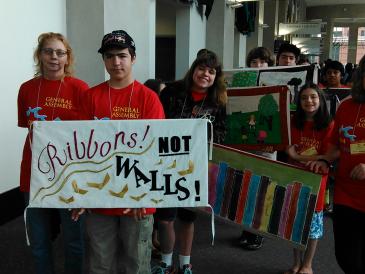
They’ve been hung from the rafters of a 19th Century barn hosting a progressive dinner dance in rural Michigan, paraded by youth for the plenary delegates at General Assembly in Providence, held by parishioners as a “living ribbon” at the close of several UU Sunday services around the country, and have welcomed customers from the walls of a neighborhood Starbucks as part of a local art walk on the south side of Chicago.   As this is written, the twenty six fabric art panels that comprise Ribbons Not Walls, a UU Humanist sponsored project on immigrant rights and culture, grace the walls at the UU Congregation of Las Vegas, for a month long program titled “Borders and Boundaries.”  It is the 50th venue for “Ribbons” since the spring of 2012, and will raise the number of viewers who have directly interacted with the art to over 8,000.

“Ribbons” began as a half dozen yard-wide panels, mostly reflecting themes and cover art from books by Hispanic authors, (see separate article on the “Banned Books” project) taken from Tucson classrooms when the State of Arizona banned “Ethnic Studies” courses.  Then the youth of the Navigator (coed, inclusive) Scouting group from Countryside UU Church in Palatine, IL contributed four batik style panels, reflecting aspects of the immigrant experience.  More contributions from a total of forty artists, working individually and in groups, were added, including depictions of humanist and UU immigration justice projects.

Of particular note are panels by the youngest and the oldest contributors – “The Wall” a rich dark acrylic on muslin rendering by 14 year old Alayana Vesto, and “Banned Books,” human figures bannered with book titles against a traditional quilt pattern, by 94 year old Gloria Weberg.  

Two panels by Linda Lee, lead artist for the Lake Apopka Farmworkers Memorial Quilt titled “Scenes from the Muck – labor and leisure” done in traditional primitive piece quilting style, toured as part of our exhibition for a year.  They have now been returned to Linda with our profound thanks - photographs of her pieces remain in the exhibition catalog.  The full farmworker quilt is known for its 128 + depictions of farmworker life, and for appearances throughout southern states at union rallies and social justice gatherings.  

The latest additions to the collection are two Commemorative panels for victims of the Los Gatos plane crash, subject of the Woodie Guthrie song “Deportee.”  For decades, activists have worked to uncover the names of the twenty eight braceros who died following their legal work on the California harvest.  Just last year the last identities were uncovered, and a new engraved headstone bearing all twenty eight names, marks the place where they were buried anonymously.  Much of the work was done by author and performance artist Tim Hernandez.  UU Humanists is proud to partner with Tim and others who worked on the 28 Deportees Memorial, by gathering small fabric panels of handprints (a sign of support) and leaves (from Guthrie’s line “Who are these Friends, all scattered like dry leaves?”) made by UU and Humanists children and adults around the country.   These are being stitched into panels, each one bearing one of the names. 

Ribbons Not Walls is an artistic response to a highly complex political issue.  In the finest humanist tradition, we use the emotional and intellectual impact of the artist’s vision, to ask audiences to engage the culture and the struggles of immigrant communities and individuals.  We do not ask you to take a particular stand (though several of the individual artists clearly do), but simply to be open to letting the works speak to you.  

The growing “Ribbons” collection will go from Nevada to Florida for at least two winter appearances, and then back north in March to be displayed at the Ohio Meadville/St. Lawrence District Meeting in Niagara Falls, NY, and then at the MidAmerica Regional Meeting in Naperville, IL.  You can also see the collection at the UU Humanists booth at the UUA General Assembly in Portland, next June.

If none of these venues are on your itinerary, perhaps you’d like to bring the Ribbons exhibit to your congregation or Humanist group.   Contact curator Roger Brewin at Rabrewin@aol.com or call him at 773 881 4028, or cell 773 551 8540 to make arrangements. Read more about Ribbons Not Walls Reaches Fifty! »

Categories: 

John's Excellent Adventure

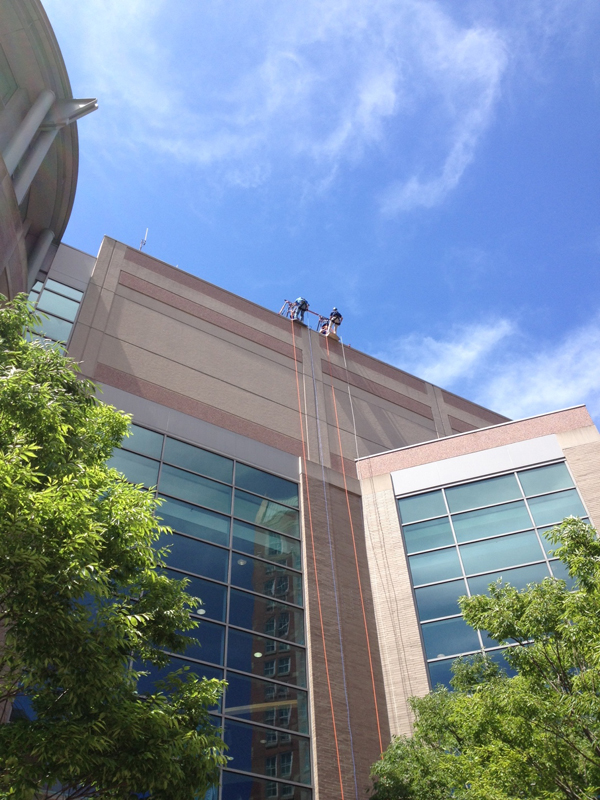
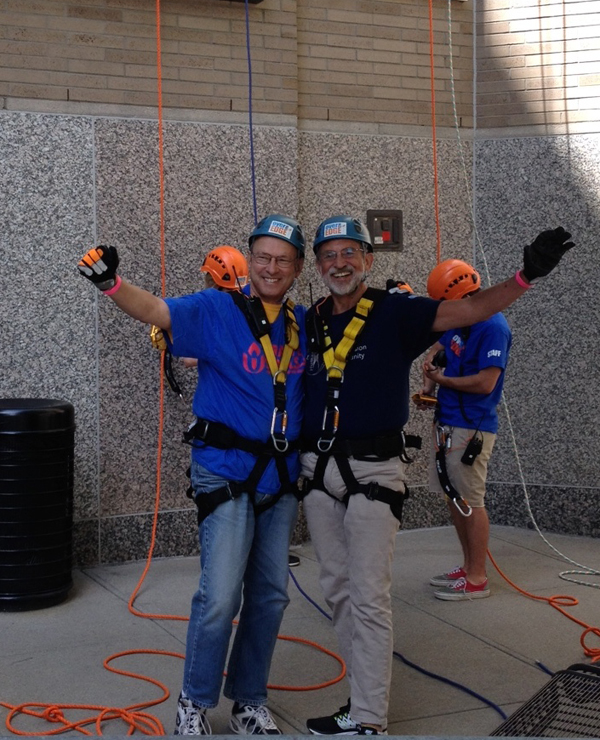
At GA in Providence this last June, some brave souls, including UUHA president John Hooper, were invited to Pledge Over the Edge in support of the Rev. Terry Sweetser Fund for Stewardship of the UUA. Here are some pictures of John and his friend from the UUA President's Council, Les Polgar, from California, rappeling down the side of the Providence Convention Center. 

Stepping Off

John Rapelling Start

Half Way

John Rapelling Half Way

They Made It!

John Rapelling End

It's hard to see through the harness, but John (on the right) is modeling his UU Humanist t-shirt. Great job, Les and John! Read more about John's Excellent Adventure »

Categories: 

The Third Way

A few years ago the so-called “new atheists” made headlines attacking belief in God and questioning the value of religion. Some of the books by Sam Harris, Richard Dawkins, Daniel Dennett, and the late Christopher Hitchens even made best seller lists. There is much to commend these works. They have managed quite well to tear down the edifice of traditional supernatural religious belief, but they have failed to offer anything to take its place. They have lumped all religious perspectives together and denounced them all as intellectually invalid and morally reprehensible.  

Humanism, however, offers a positive and affirming view of life without a supernatural God. I believe it is not enough to be critical of traditional religion and religious belief unless you can offer something to replace them. This is the difference between mere atheism, which is negative, and Humanism, which is positive and affirming. Humanism is much more than atheism. Atheism means denying the existence of a supernatural deity, but we human beings seek meaning and purpose, and we want to know how to live happy and fulfilling lives. Humanism offers those things, so I talk and write about what Humanism affirms, not what it denies, about Humanism as a morally responsible and joyous way of living.

A positive Humanism is not primarily about the supernatural beliefs we reject; it is about the values we stand FOR, and we stand for human well-being, human flourishing. We stand for social justice and equity for all people, for these affect the quality of life of everyone. Human-ism is about the worth and dignity of every human being. It is about respecting persons and caring about each person’s well-being, and it is opposed to whatever decreases the flourishing of any human being any where at any time.

When it comes to religion, most people, I believe, assume we have only two alternatives: either accept traditional religion or reject it. But there is a third alternative -- humanism, which includes the best values and principles of traditional religion without requiring us to believe in the superstitions, irrational beliefs and dogmas of traditional religions, but not leaving us adrift without meaningful convictions and a reason to live that is the danger of atheism and agnosticism. For those of us for whom the stories and myths of traditional religion have lost their power as well as their believability, and for whom reason and intellectual honesty are central, this third way can make a lot of sense.

Humanism has two branches -- religious Humanism and secular Humanism. They have the same beliefs. The major difference is that religious Humanists find value in being part of a community of people with similar values and beliefs whereas most secular Humanists choose not to be part of such a community. Some religious Humanists prefer to be known as “congregational Humanists” since the word religious has theistic connotations to most people.

Religious or congregational Humanists are found in three institutions: Unitarian Universalist congregations, Ethical societies (a.k.a. Ethical Culture), and Humanistic Judaism congregations.

So I suggest that Humanism offers a third way, a way that includes the best of the critique of traditional religions of people like Richard Dawkins and Sam Harris, and the best values of the traditional religions. It is a lifestance that makes sense today in the 21st century, that speaks to our time in a meaningful and powerful way, a perspective grounded in the natural, not in the supernatural; a perspective that emphasizes the worth and dignity of human beings rather than the glory of God; and a perspective that understands living well and social responsibility to be of far greater importance than personal piety. Read more about The Third Way »

Categories: 

Pages

Subscribe to Front page feed