Humanism and Unitarianism: Final Class Words

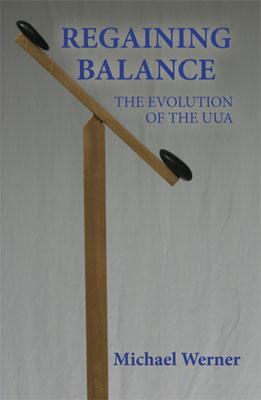
[Editor's note: Mike Werner, author of Regaining Balance: The Evolution of the UUA, recently taught a class for SecularActivism.org called "Humanism and Unitarianism". Here are his "final words" to the class as it wrapped up. What are your thoughts?]

What can we learn from the Unitarian Universalist experience that can be applied to building humanist communities of the future?

1) Once you lose your focus; your market brand it is hard to regain it. Trying to be all things to all people does not work. People want their religion narrowly focused and meaningful. Every study puts being with like mind people as the main reason to be in our movement, not to be with people vastly different than them. If Humanist groups defocus their energies in supporting the merely humanistic, rather than the naturalistic humanists, the humanism within it is lost eventually.

2) Postmodernism’s poisonous ideology of radical relativism undermines all of progressive liberalism. We may not have certainty, but science provides us tools to explain, make prediction and control the world. Science is true because it works despite the fact that is gives us knowledge that is fallible, tentative, and probabilistic.

3) Always keep a balance of our highest values and don’t let any of them become secular god. Tolerance, reason, justice, love, compassion are all great values, but never have any of them overwhelm all the others.

4) There is no single model of a humanist community that will work. We need multiple models and even within our communities we more than ever need a “cafeteria” of alternatives. Many of the most successful atheist communities are merely social gatherings, or “Drinking skeptically” as some are known. Most of the atheist youth are not involved with organized groups and seek the blogosphere and social media for their community. How do we capture that?

5) Professional leadership may actually harm a group’s growth. You can tell the inflection point in a religious denominations growth curve when professional leadership comes on board. We don’t understand all the reason for this, but the religious ministerial model may not work in the future. What may work is professional leadership that acts more as a coordinator, educator and manager than a minister.

6) The UUA does community real well and humanism very poorly. It used to do both well. The humanist communities, by and large, do humanism very well and really fall short on skills to build intentional communities. How do we do both?

7) Many young people enter the UUA when their children start asking questions. Parents want a liberal community for their children that nurtures, educates and lets the children know they are not alone in their beliefs. The UUA cannot hold onto children because they don’t provide an evocative grounding. Hodding Carter is famously quoted saying, “There are only two lasting bequests we can hope to give our children. One of these is roots, the other, wings.” We do great on the wings, but the children are left to fly direction-less which is possibly why the UUA has the lowest retention ratio of any denomination at only 12%.

8) Be careful with words. Words have the power to create meanings or destroy them. I think it is more than time to withdraw from the religious redefinition game. Even John Dewey saw his use of religious language as metaphor as an evolutionary technique not a revolutionary one. While many may think the language of reverence is inclusive, that it is not for the vast majority of humanists.  Millenials, in particular, have a great distaste for the religious redefinition game.  It decidedly favors the theistic point of view.

9) Lastly, Humanism is a blend of both the Enlightenment and the Romantic projects and a full humanism embraces both the heart and the mind, reason and compassion.

I originally asked you why you are here. I think you and I are here because we want a better world. We want a better world, but we believe that secular values, indeed Humanist values will make a better world. This isn’t just about the “right-ness of our cause, but the practical effects. There is something more though.

Our hearts long for an integrated whole view of life that matches with reality. We long for a vital center to our lives that both grounds us and inspires us, a vision of grander authenticity to our lives and not just smaller truths. All of us long for an evocative whole story and higher vision that lifts our hearts, moves our society, pushes us to higher meanings, and ennobles our lives. Some may find that integrated story is already there in the balanced humanist secular life of here and now, of heart and mind, reason and compassion, accepting the exhilarating challenge of moving toward a responsible search for truth and meaning.

The humanist lifestance is based on our values, not our beliefs, where open-minded critical thinking, science, justice, freedom, tolerance, democracy, compassion, human rights, inherent worth and dignity, and human flourishing hold our web of belief together.

We can’t afford the luxury of just critiquing religion. We must tell our alternate story so that those contemplating change know there is an alternate worldview that can support, inspire, and comfort them; that the knowledge of science, while tentative, is surely firmer than blind faith; that the exhilaration of focusing on the here and now is more meaningful than otherworldliness; that hope and love are certainly better than hate and divisiveness; that compassion and responsibility can be balanced with self-interest and freedom. That ambiguity that is inherent in all our value/ethical/political choices we spoke of earlier need not paralyze us, but it does make it even more important we reflectively consider all our choices.

Humanist ethics derives its power by affirming the inherent worth and dignity of all people and realizes that if justice is to be given only we can give it. If love is to be given only we have the power in this moment and in this hour. By not doing so, the opportunity is lost forever. Suffering not relieved is real suffering, not washed away by the hand of a loving god when we die. This world is all and enough. Enough to fill us with joy and wonder and hope and awe that is our natural birth right.

Now is our time and now is our chance to move society toward reason and the good life. Now is our time to move society out of the dark ages of theocratic and ideological control toward human fulfillment. We cannot falter in the face of certain hostility, our own inherent ambiguity, and we cannot stand idly by hoping for a secular society to automatically shape itself. It is our duty to show that a secular world need not end in nihilism, but we can build communities that embrace a progressive, humanist, ethical worldview of human and global good. Read more about Humanism and Unitarianism: Final Class Words »
Categories: 

GA Program: Reaching Out to the Nonreligious

Listen to the Audio: 

How can UU congregations and ministers make their non-theist members feel welcome and included? The UU Humanist Association sponsored a panel discussion at the 2014 UUA General Assembly in Providence, RI to consider a number of different ways.

We discussed three main approaches to providing a comfortable environment:

  1. Dedicate the entire congegation to Humanism. This is the approach taken by Rev. David Breeden's First Unitarian Society in Minneapolis, MN, the "flagship" Humanist congregation in the UUA. This can work well, especially in an area where there are several UU congregations where one can "specialize" in Humanism.
  2. Have a regular Humanist service. This is how Senior Minister Marlin Lavanhar's congregation, All Souls Unitarian Church in Tulsa, OK, dealt with a merger that resulted in a very theologically-diverse membership.
  3. Build a strong Humanist local group for mutual support. Chris Stedman, author of the book "Faithiest" and now of the Yale Humanist Community, and Sonia David, an intern at the Humanist Community at Harvard, are working to develop this model.

You can watch the entire presentation here (audio quality is not great) or listen to it below.

A special thank you to our friend Steve Ahlquist from the Humanists of Rhode Island for the video and pictures! Read more about GA Program: Reaching Out to the Nonreligious »

Categories: 

The Business of Government -- Prayer and Pledge Go Hand-in-Hand

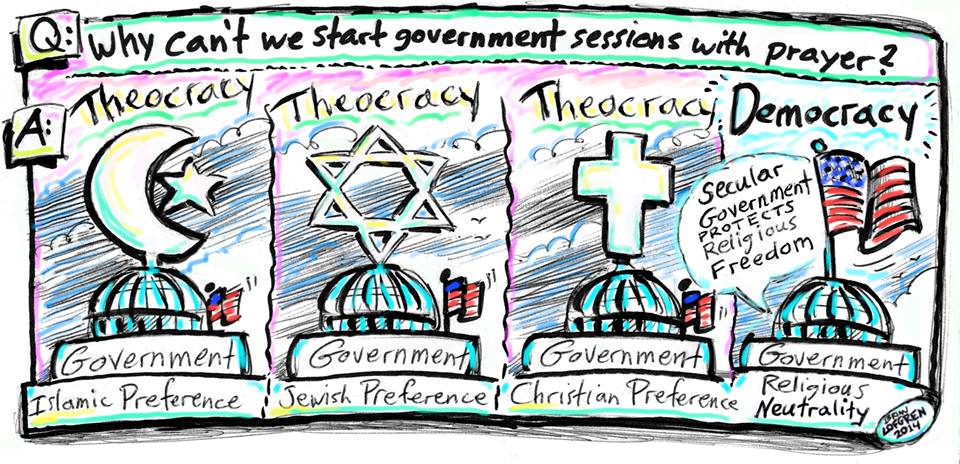
[Editor's note: This post is by Ellery Schempp, plaintiff on the 1963 Abington v. Schempp Supreme Court case against school prayer and soon-to-be recipient of the UU Humansts' 2014 Religious Humanist of the Year award. The graphic is by member Brian Lofgren.]

I am extremely disappointed in today's Supreme Court decision (Greece v. Galloway) affirming that sectarian prayers at city council meetings do not violate the Establishment Clause of the First Amendment.  The 5-4 decision severely diminishes the non-establishment principle and effectively endorses majoritarian displays of public piety.

The notion of public prayer before council meetings is itself rather weird, a 'theological/religious' notion that praying somehow leads to better government, or that some supernatural entity will show favoritism to get better roads in communities that pray.  This is naked superstition, a bow to witchcraft-like incantations, and acceptance of magical thinking. Like school kids praying before an exam---but it is better to have read the assignments and done the homework. 

It is wholly disingenuous to imagine, as Kennedy does, that public prayer is not subtly coercive.  It should be obvious that such prayers create an atmosphere that a certain god has to be prayed to to win its favor.  And surely such prayers promote the idea that the government favors some religions or some gods over others.

It is made worse by having the Pledge, with the phrase "under god", following the prayer. The linkage between a prayer and a god-belief as being vital for genuine Americanism is obvious.  That prayer and Pledge go hand-in-hand reinforces the notion that a certain god or religion is more "official" and patriotic than others.

It is also rather weird to imagine that clergy who pray such&such have some insight that others do not have.  Clergy, of course, are not elected; and have as their agenda, continuing income from their congregation.  City councilors have an agenda to get re-elected by doing good for their communities.  There is a difference.

The decision wholly ignores non-believers, non-theists, atheists who have no use for prayer to an imaginary deity.  It is even an affront to the Founding Fathers, many of whom were Deists, who rejected the notion that God would intervene in human affairs as a result of supplication and worship.  George Washington, Madison, Jefferson, Franklin, even Adams, would be appalled at today's decision.  The idea of a government body paying obeisance is anathema to the legacy of Roger Williams.

The decision is a major attack on a memorable phrase from the Supreme Court's Engel decision (1962):  "It is no part of the business of government to be composing prayers..."  This principle is a vitally important reminder.  What is the proper business of government?  Is having a prayer calling on Divine Providence and some dogma about Jesus going to help with the sewer works? 

The decision will do no good for public policies, no good for good government, no good for welcoming minority participation in community government, and will only reinforce various power structures that buy into the majority religion.

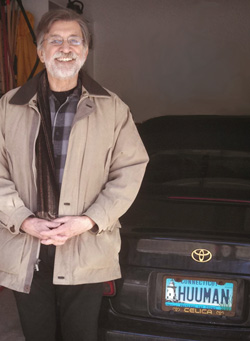
Ellery Schempp

  Read more about The Business of Government -- Prayer and Pledge Go Hand-in-Hand »

Categories: 

President's Corner

The Mission of your Unitarian Universalist Humanist Association (HUUmanists) is two-fold:

1.     Promote a broad acceptance of Humanism in our society, particularly throughout the Unitarian Universalist Association and its congregations; and

2.     Provide an active interface between Unitarian Universalists and the secular community.

Your extraordinary Board of Directors and I strive to make sure that all of our initiatives are clearly mission-based. 

In December, 2013, Maria Greene, formerly the HUUmanist Association secretary, took on the position of  Director of Development and Communication for our Association.  Maria is a graduate engineer, an entrepreneur, and an active local leader in the eastern Massachusetts area Humanists and secular groups.  Thanks to Maria we now have up-to-date and active communications mechanisms, including a vibrant web and Facebook presence.  Activity in our local groups projects and special events have taken off under Maria’s guidance.  You will learn about some of the results of her efforts later in this newsletter.

Our relationship with the Unitarian Universalist Association (UUA) continues to deepen.  Maria, HUUmanist board member Lowell Steinbrenner, a few leaders from the non-UU secular community and I are participating in a video conference with members of the UUA staff.  This activity is called the “Innovative Learning Circle on Humanism in Unitarian Universalism.”  These monthly interactive meetings are sponsored by the UUA Office of Growth Strategies.  The “learnings” from these discussions are passed on to UUA leadership for possible action.  The most recent session covered the use of religious language and the impediment it may cause in attracting young people to UU congregations.  This forum is proving to be an important means to make our case with the right people in the UUA.  We’ll keep you posted.

The UUA has joined HUUmanists in supporting Greg Epstein’s Humanist Community Project (HCP).  Flagship UU programs such as “Our Whole Lives” may be adapted for use by local secular or Humanist groups through cooperative arrangements with the UUA, HUUmanists, and HCP.  HUU Board member, Lowell Steinbrenner and I serve on the HCP Advisory Board.  HUUmanists, the UUA, the Unitarian Universalist Funding Panel, and individual UUs have invested over $25,000 total in HCP.  It was my pleasure to present Greg with a check for $5, 000 from HUUmanist Association at the Grand Opening of the Humanist Community at Harvard’s “Humanist Hub” in Cambridge , MA.  Maria Greene serves as our representative to the HCP project team.  This represents a great opportunity to involve UUs in establishing Humanist communities across the country.

Board member Roger Brewin has been on the road spreading the news about UU Humanism and the two social justice projects that he spearheads: Ribbons Not Walls and the Banned Books Project. You can read more about his travels and those projects in separate articles. Roger's energy and goodwill make him a fantastic embassador for UU Humanism. 

Board member and author Dr. Bill Murry was honored in April by the UU Church of Worcester, MA  with the  2014 Dr. Irving & Annabel Wolfson Award for his contributions to Humanism. Bill gave an inspiring lecture titled “Religious Humanism: Reason and Reverence in an Age of Science”.

Thanks for your continued support of the UU Humanists and I look forward to seeing many of you in person at the UUA General Assembly in June. Read more about President's Corner »

Categories: 

Join the UU Humanists at the UUA General Assembly in Providence, RI this June

We hope we will see you at the UUA GA next month. We have a big presence planned:

  • Come visit us in the Exhibit Hall, booth 416.
  • Attend our program, "Reaching Out to the Nonreligious" and find out how to make your congregation welcoming to non-theists.
  • Join us at our Annual Meeting for some brief but important business items, including:
    • officially changing our name to the Unitarian Universalist Humanist Association,
    • adopting new bylaws that allow for more modern forms of voting in the future.

      Make sure your UU Humanist membership is up-to-date so you will be included in the quorum.
  • Express your support for the Separation of Church & State at the "Schempp Schindigg".
Categories: 

Humanist Oasis in the GA Exhibit Hall

Booth 416

Drink deep from the latest books by our own Humanist Press authors and other Humanist writers; dive into a pool of nationwide social justice opportunities - immigration reform and opposition to censorship; quench your thirst for updates on cooperative projects on leadership training and humanist community. 

All this and the latest info on local Humanist groups and programs in the UU universe; engagement with representatives of local and regional secular organizations; the latest copy of the Journal of Religious Humanism and a collection of freethought wit and wisdom on stickers, pins and magnets.

Plus the chance to meet and greet HUU Board members and booth volunteers - experts tell us they are the liveliest folks at the General Assembly!

Stop by - refresh yourself, ask a question, give your opinion, renew your membership, get a UU Humanist namebadge ribbon to show your Humanist pride, peruse the displays, purchase a pin-on, stick-on slogan or some more substantial reading, make a new commitment to humanist values, make a new friend, make your day at GA!

Some say it will be worth the trip to Providence just to stop by the HUUmanists booth; some say you sense a deep and resonant pulsing there that is the heartbeat of UUism; some say you can't have more fun with your clothes on; all we know is - it's all good, but it won't be perfect till you get there.  See you at the booth?

  Read more about Humanist Oasis in the GA Exhibit Hall »

Categories: 

Our GA Program: "Reaching Out to the Nonreligious"

Friday, June 27, 5:00 -- 6:15 pm, RICC -- Hall D

People (especially young people) who profess no formal religious affiliation make up one of the fastest growing segments of our population. Three approaches to carrying our message to a large fraction of these so-called "NONEs" will be described and celebrated: The Humanist Congregation, The Humanist Service, and the Humanist Community. Read more about Our GA Program: "Reaching Out to the Nonreligious" »

Categories: 

Ellery Schempp Accepts the "Religious Humanist of the Year" Award

Friday, June 27, 7:00 – 9:00 pm, RICC – Hall D

Come celebrate the lifetime achievements of UU Humanist Ellery Schempp during the "Schempp Schindigg" immediately following our Annual Business Meeting. We will honor Ellery with our 2014 Religious Humanist of the Year Award, hear from prominent leaders in the secular movement who are fighting to maintain the wall of separation between church and state, then hear from the man himself.

This meeting will be open to the public and invitations are being sent to secular local groups throughout the New England area. The evening will include light food and much laughter as we celebrate past Supreme Court victories, like Abington v. Schempp, that determined that school prayer was unconstitutional, while we network with each other to increase our resolve to continue the fight! Read more about Ellery Schempp Accepts the "Religious Humanist of the Year" Award »

Categories: 

"Ribbons Not Walls" Social Justice Project Update

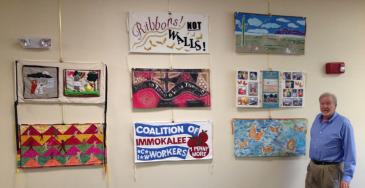
The fabric arts/social justice project that began prior to last year's GA, and was featured at the HUUmanists booth in Louisville, began its second spring tour in April. Two dozen panels on various immigration themes have been shown in seven venues over the winter including three midwest UU fellowships, a minister's study group and and a Democratic party dinner. Recent and upcoming presentations in three humanist groups in Michigan and Kentucky, Regional and District UU Meetings in Bloomington and Vero Beach, and three UU congregations, including a month long show in the gallery of Thomas Jefferson UU Church in Louisville.   

The twenty five panels, made by over 40 humanist and UU artists around the country (ranging in age from 13 to 94) cover a wide spectrum of immigration related issues, and showcase half a dozen styles from traditional quilting to batik.  The newest additions are commemorative panels containing the names of the previously anonymous Braceros who died in the 1948 Los Gatos plane crash, made famous by the Woody Guthrie song, "Deportee."  These plus all of the original pieces will be part of the HUUmanists booth at GA 2014 in Providence, RI.  Included this year will be a parade of all the artwork throughout the convention center, by fifth through eighth grade children participating in the GA camp on identity and oppression.

Please contact Roger Brewin (773 881 4028, 773 551 8540 rabrewin@aol.com) or at the HUU booth at GA if you are 

a)  a congregation or group with an interest in immigration reform who wish to arrange a future showing of or programs about the art work, 

b) an artist who works in fabric media who wishes to submit an idea for additional panels;

c) an individual or group wishing to sponsor a panel. 

  Read more about "Ribbons Not Walls" Social Justice Project Update »

Categories: 

Pages

Subscribe to Front page feed