This is my presentation from the "Freethinker Friendly" part of the "Serving the Nonreligious" program at the 2015 UUA General Assembly in Portland, OR on Friday, June 26. I am Maria Greene, the part-time Executive Director of the UU Humanist Association.
Freethinker Friendly is a program of the UU Humanist Association with the goal of helping congregations communicate to their communities that they are welcoming to atheist, agnostic, humanist, and other freethinkers. You can find out more about the program and register your interest on the Programs > Freethinker Friendly page of this website.
Listen to the Presentation
[A special thank you to AdamGonnerman for creating the video version of this presentation.]
This is Kevin Jagoe's part of the "Serving the Nonreligious" talk at the 2015 UUA General Assembly in Portland, OR on Friday, June 26. Kevin is the Media Coordinator and Youth Director at First Unitarian Society, Minneapolis and the newly-elected Member-at-Large of the board of the UU Humanist Association.
In this presentation, Kevin discusses the outreach efforts he is involved with at FUS, and encourages other UU congregations to offer things that humanists and other freethinkers are truly interested in.
Listen to the Presentation
[A special thank you to AdamGonnerman for creating the video version of this presentation.]
This talk by Rev. David Breeden was part of the "Serving the Non-Religious" session at the 2015 UUA General Assembly in Portland, OR on Friday, June 26. David is the senior minister of the First Unitarian Society of Minneapolis which has, "A heritage of forward-thinking humanism at home in the here and now". In this talk, David discusses the changing religious landscape of the FUS neighborhood, and by extension the country at large, then suggests how Unitarian Universalist congregations are going to need to adjust their programming and their thinking to thrive in the new reality.
Listen to the Presentation
[A special thank you to AdamGonnerman for creating the video version of this presentation.]
Slides and Transcript
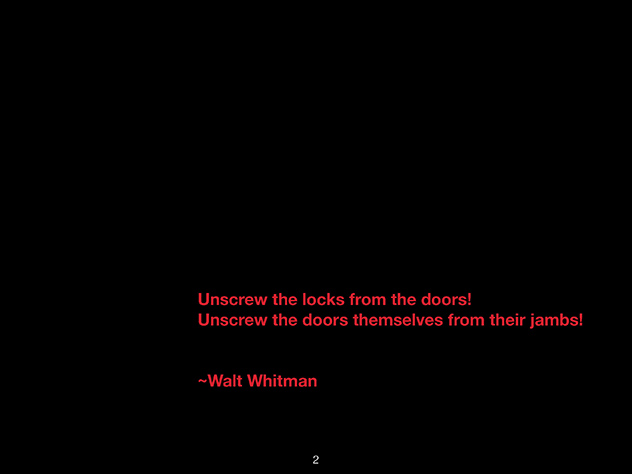
Perhaps Walt Whitman said it best a long time ago: “Unscrew the locks from the doors! / Unscrew the doors themselves from their jambs.”
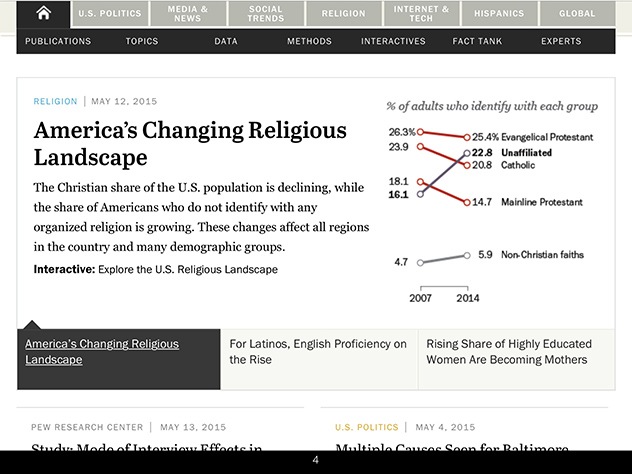
You’ve read the Pew results. You’ve heard arguments about what they mean. The data says that one-quarter of Americans who would at one time have been expected to identify as Christian—that are “tradition Christians”— . . . now don’t identify as such.
Perhaps business entrepreneur Seth Godin best summarizes the conundrum for mainline Protestant congregations:
“You are yelling at people who think they have a problem that you can't solve . . .”
Well, frankly, I’m very skeptical that institutional religions CAN solve the problems that most Americans face today.
People are voting with their feet, and I’m not inclined toward making the patriarchal assumption that they’re all merely confused children and that some thinking about religion would do them good.
I don’t think traditional religions have much more to offer than some bells, candles, buildings, and some interesting texts. That’s the way it has been for me for a long time . . .
I know that by saying that, I’m in danger of walking into the trap of saying that religions should be consumerist, should make the customer happy.
To which I say, that’s the way religion does now and has always functioned in the United States . . .
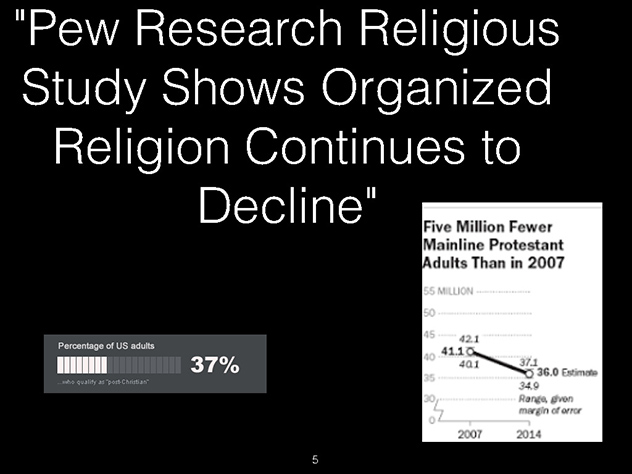
Pew says it, as does the Barna Group, a research group funded by churches on the more conservative end of the spectrum, estimates that more than 1/3—37 percent—of Americans are, what they call, “post-Christian.”
Again, let’s entertain this thought: What if that 37 percent of Americans are NOT confused about their best interests? What if they are best served by leaving traditional religions behind?
Let’s face it: it was humanism, not religion, that brought same-sex marriage to the United States. It was humanism that won the victory recently when the voters of Ireland—a country that Irish writer James Joyce described as “priest ridden”—when voters approved same-sex marriage.
Humanism won. Roman Catholicism lost.
What if the Church is wrong and the people voting with their consciences and their feet are right?
Call it consumerist. Or give people credit for realizing that their need for meaning and purpose is not met within conventional religious structures.
I blog about such matters . . .
and here is a response that I got in the comment section.
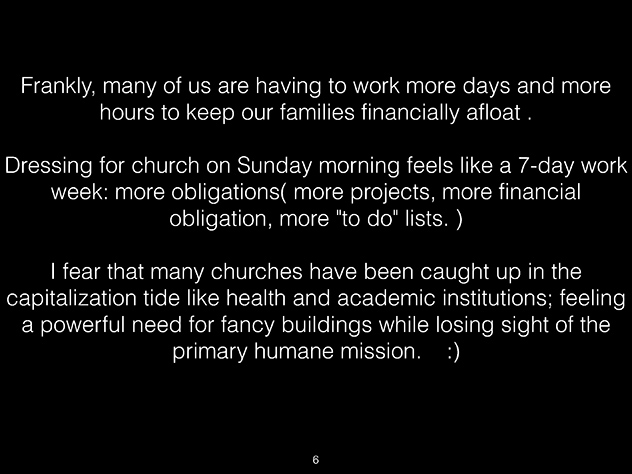
Frankly, many of us are having to work more days and more hours to keep our families financially afloat .
Dressing for church on Sunday morning feels like a 7-day work week: more obligations (more projects, more financial obligation, more "to do" lists. )
I fear that many churches have been caught up in the capitalization tide like health and academic institutions; feeling a powerful need for fancy buildings, while losing sight of the primary humane mission. :)
Now, this woman is addressing two very different issues, one a matter of programming, and one a matter of a much deeper institutional problem.
Is this woman a candidate for Unitarian Universalism IF we can get the time right for services, or has she left the organized religion building entirely because institutions have stopped serving her needs and began to serve only their own?
Which leads to my central question for today:
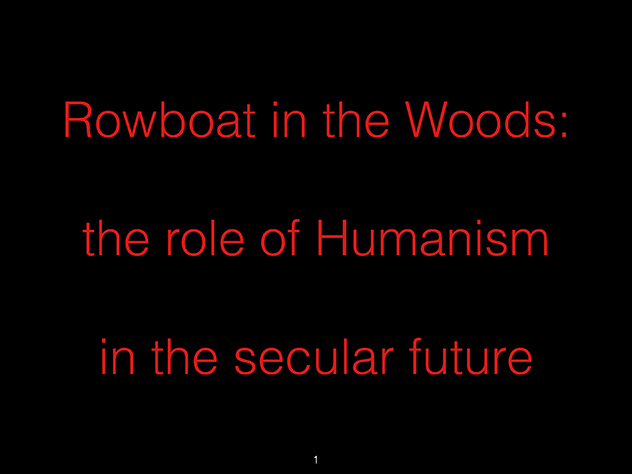
Is the congregational model a rowboat in the woods?
A rowboat in the woods. Yes, once there was water; now, there’s not.
You see, with a good deal of effort, you can keep rowing a rowboat in the woods.
It will keep going.
In addition, we know that there are bays and creeks and streams still out there where a rowboat is a very fine mode of transportation . . .
Rowboats are very fine. But is the congregational model now a rowboat in the woods in many locations and situations?
Further, even when the rowboat is still in water—can it stay afloat? Studies say that it takes eight Gen Xers and Millennials to make up the financial giving of one Boomer. Does your congregation have a plan for growing that much over the next ten to twenty years? If not, you have a problem.
That question is the existential one that congregations, especially ones with old buildings, need to look at; and it’s the question newer groups need to ask when the question of building or buying a building comes up—is that building and the assumptions about how congregations function an outmoded form?
Are you buying yourself a rowboat in the woods?
Each group has to figure that out for themselves. I’ll go into detail about the situation of First U in Minneapolis to perhaps get your thoughts going.
First, FUS is an institution.
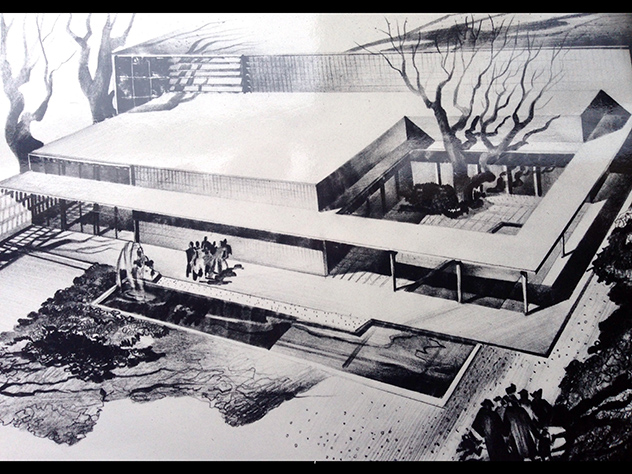
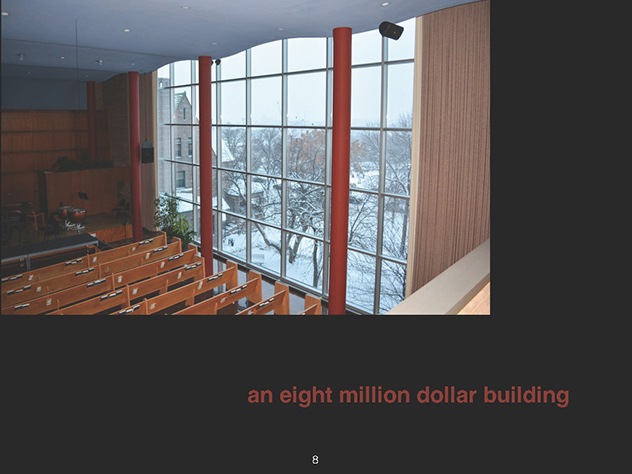
We have an eight million dollar building
with three million dollars worth of deferred maintenance.
Here’s our situation:
First Unitarian Society of Minneapolis has 450 adult members and gets about a dozen new visitors per week.
The building sits on a hill overlooking the Walker Art Gallery—an internationally known contemporary art museum—and we are near the Gallery’s sculpture garden, where Claus Olderberg’s “Spoon Bridge and Cherry” draws millions of visitors per year—it is the number one tourist attraction in the Twin Cities.
Our building is in a high-rent district where condos sell in the neighborhood of a million dollars apiece. Not a month goes by that we do not get an offer on our building.
That’s the challenge of the building.
Then there’s the competition. Now, I realize that all congregations have different competition—the South or the West or the East are not like the Midwest. Each congregation has to assess its own situation. But here’s the one my congregation faces:
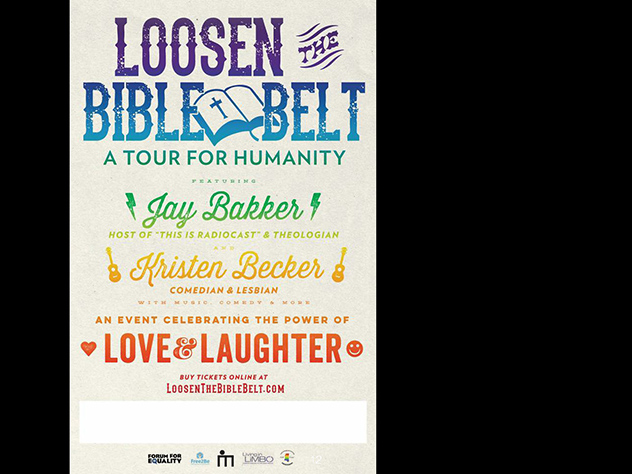
Jay Bakker, son of Jim and Tammy Faye Bakker, hosts services at a nearby bowling alley bar. He performs weddings for same-sex couples underneath that spoon and cherry you just saw. And he is an evangelical Christian.
Note this tour poster. His fellow traveler is, as he notes, a “comedian and lesbian.” Evangelical Christianity is not what it used to be!
Liberal Christianity—often touted as the rejuvenated future of Unitarian Universalism—is not in short supply in the Twin Cities.
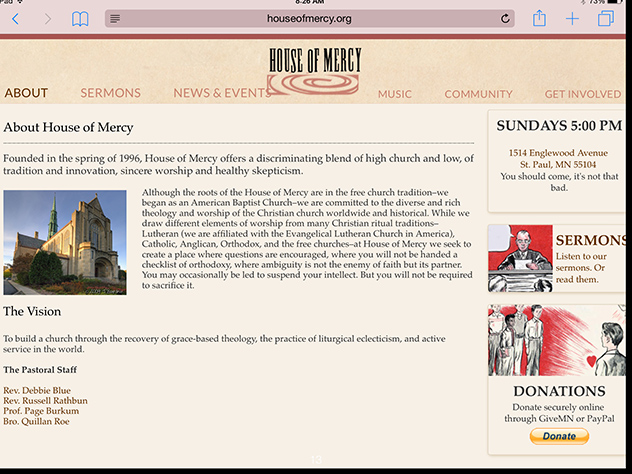
This church, for example, is affiliated with the American Baptists and ELCA Lutherans, and you will notice that they claim to use traditions also from Roman Catholics, Episcopalians, and the “free churches.”
Their slogan, on the right hand side of the slide, is “You should come, it’s not that bad.” They have a house rock band and a recording studio.
Notice their claim: “You may occasionally be led to suspend your intellect. But you will not be required to sacrifice it.” (Sounds positively UU, doesn’t it?)
That’s the competition. In terms of the institution I direct, Christianity Lite and Theism Lite is a saturated market. And a market saturated by groups that can do a vastly better job at it than we can—they speak the language, they know the songs.
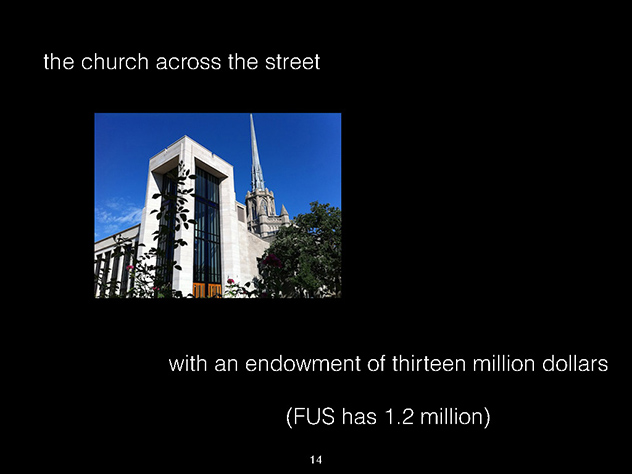
Take for example the United Methodist Church right across the street from First Unitarian Society. They have an endowment of 13 million dollars. We have an endowment of 1.2.
They have four services on Sunday morning, ranging from traditional to . . .
Well . . . their 8:30am service occurs in an art gallery and sports a jazz band. They invite people to ask “questions, sing their joy, to dance and laugh, and to create prayer that grounds all in the goodness of Creation.” (No: interpretive dance is not just for UUs any more!)
By the way: those of a theological bent will notice that the “goodness of Creation” is NOT part of the Methodist creed. The new normal for our liberal religious competition is that they do not adhere to the creeds that have defined their traditions—they’ve heard of the “spiritual but not religious” as well and they are changing their programming accordingly.
In other words, many liberal Christian congregations have become creed-less.
(UUism is not unique in that.)
I have breakfast with the minister of this congregation once a month. Recently he said, “Oh, sure, that early service is Unitarian!” They know what they’re doing . . .
Their 11:15 service is based on the Iona Community of Scotland. If you’re not familiar, the Iona tradition is part of Celtic Christianity and focuses on immediate experience of the sacred and especially on social justice.
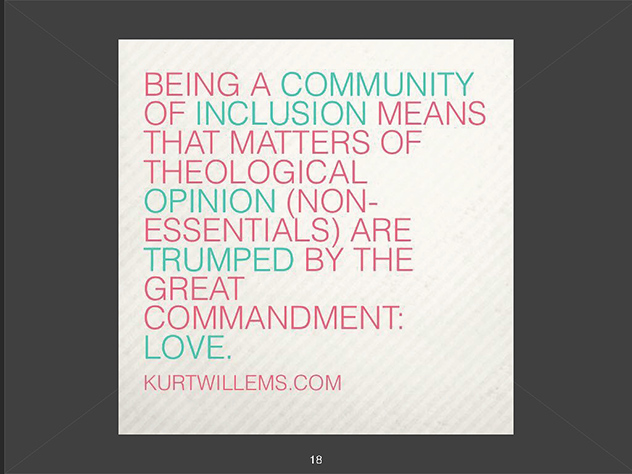
For those of you not familiar with Kurt Willems, he’s a contemporary Christian theologian. What he has to say sounds a lot like Unitarian Universalism:
“Being a community of inclusion means that matters of theological opinion (non-essentials) are trumped by the great commandment: love.” You will notice that the sentence is grammatically ambiguous—are all matters of theological opinion “non-essential” or are there some essential ones? At least in this sentence, Kurt Willems is not saying . . .
That’s the competition for my congregation from the liberal Christians: all of these institutions and ministers have read the Pew research handwriting on the wall and found traditional Christian doctrine wanting.
And they are willing and able to do something about that . . .
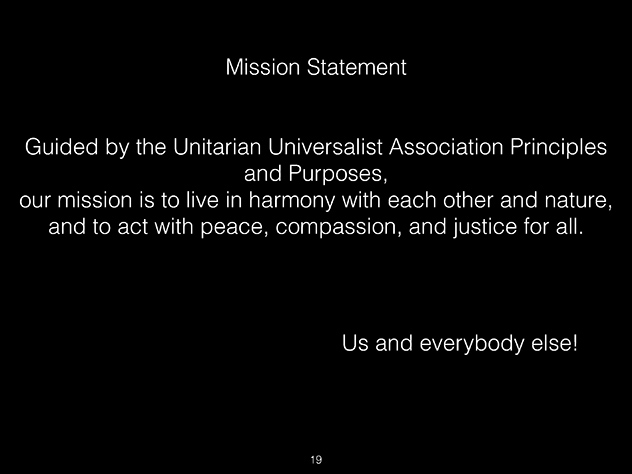
And then there’s us, the UUs. Take a look at this—a mission statement I found randomly on the web: “Guided by UUA principles and purposes, our mission is to live in harmony with each other and nature, and to act with peace, compassion, and justice for all.”
Now . . . tell me . . . which of the Christian congregations I’ve shown you would disagree with that? That’s not a mission statement. That’s baby food, and the liberal Christians that I’ve shown you will chew that church up and spit it out.
It’s time that UU congregations wake up and consider what existentialist philosopher Albert Camus pointed out as the first question of philosophy: “Why not commit suicide?”
Camus suggested that each of us ask ourselves that question in the mirror when we get up each day.
UU congregations need to ask a similar question: “Why not close our doors?”
“What are we doing that others are not?”
Are we peddling a liberalized, open-minded, form of theism that’s open to the currents of American culture with yoga and mindfulness and what-have-you thrown in for good measure?
Well . . . so are lots of other churches—and as the numbers of available bodies drop—as everybody fights to grew that congregation to eight times its Boomer-era size—traditional UUism will not win. The Mainline denominations are going to keep shifting their message—and ignoring their creeds—to get warm bodies into the pews. Some will remain rowboats, despite the hard rowing in the woods; some of them are going to figure out another method of propulsion . . .
We—all the leaders in UU congregations—do well to ask ourselves: “Why not shut the doors and go home?” We need to look at ourselves in the mirror and ask: “Why are we asking that single parent to pony up to pay for a building and a staff?”
What is she getting in return?
One solution to this problem, I propose, is for UU congregations to stop attempting to out-do Christian congregations on the field of liberal theism I propose the we look to our “usable past” and find something Christian churches aren’t going to do.
Unitarian Universalism has something in its skill set that Christian traditions do not: Humanism.
I am a “missional preacher” as the saying goes nowadays.
My mission is spreading the the good news of Humanism in our secularizing world—to that one quarter of the population who have left organized religion. And I for one don’t think they should go back.
When I discovered agnosticism and atheism, forty years ago, I joined about one percent of the population. Now, atheists and agnostics make up nearly eight percent of the US population. Small. But growing . . . exponentially.
There is at last a critical mass of people prepared to see reality as human knowledge shows it to be rather than as human fantasy would like it to be. This is the humanist moment.
When we consider who our potential new members are at First Unitarian Society, we think not of those looking for a vague sense of past Christian tradition, not those running from religion’s more traditional forms, but for those who have no religious background at all . . . a growing number of Americans.
What is Humanism, by the way? It needs to be defined. Here’s my definition:
Humanism is an evidence-based value system dedicated to freedom of thought and promoting the well-being of the planet and all living things.
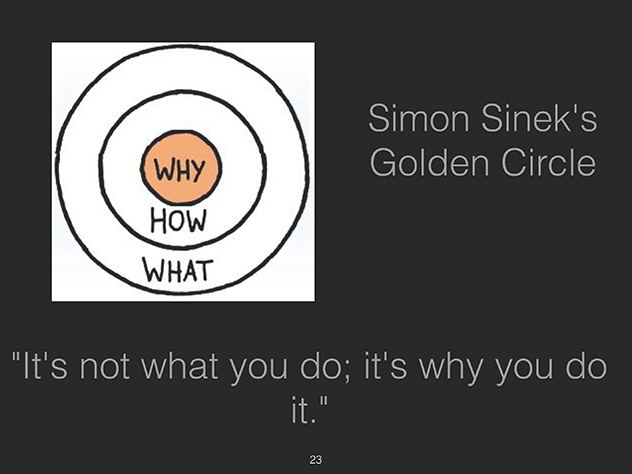
Simon Sinek is an author in the crowded field of management theory (perhaps you’ve seen his excellent TED Talk).
Sinek insists—and it makes sense to me—that successful businesses start with “why.” In his phrase, “It’s not what you do, it’s why you do it. “
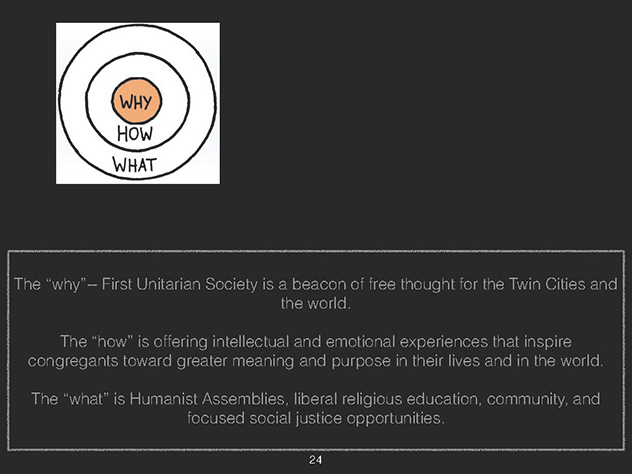
I think that’s a good question to ask, and the answer to the question is your . . . mission.
The “Why”—First Unitarian Society is a beacon of free thought for the Twin Cities and and the world.”
The “How” is offering intellectual and emotional experiences that inspire congregants toward greater meaning and purpose in their lives and in the world.
The “What” is Humanist Assemblies, liberal religious education for children and adults, community, and social justice opportunities.
I am deeply convinced that Jesus would most likely say nowadays, “those who seek to save their building shall lose it, but those who have a mission shall have everlasting coffee hours.”
What can Humanism do that conventional UU congregations often don’t do?
Carey Nieuwhof, minister and author of churchleaders.com, put it this way:
• There is a crisis of meaning, not information.
• There is a crisis of connection, not followers.
• There is a crisis of direction, not options.
That gets at our usable past: Humanism. And our core values: freeing the mind and saving the world.
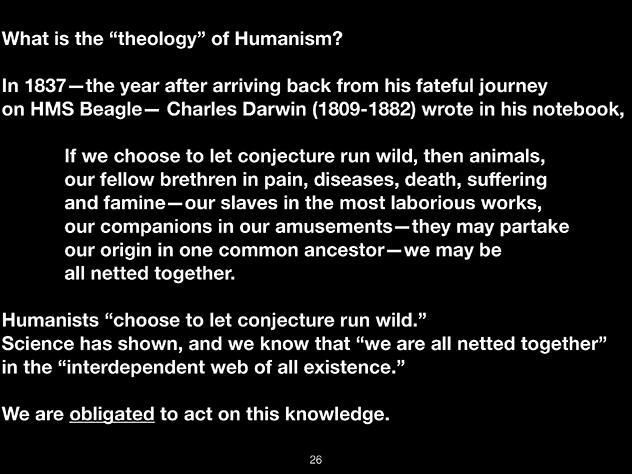
What is the “theology” of Humanism?
In 1837—the year after arriving back from his fateful journey on HMS Beagle— Charles Darwin (1809-1882) wrote in his notebook,
If we choose to let conjecture run wild, then animals, our fellow brethren in pain, diseases, death, suffering and famine—our slaves in the most laborious works, our companions in our amusements—they may partake our origin in one common ancestor—we may be all netted together.
Humanists “choose to let conjecture run wild.” Science has shown, and we know that “we are all netted together” in the “interdependent web of all existence.”
We are obligated to act on this knowledge.
The usable past of UUism is Humanism.
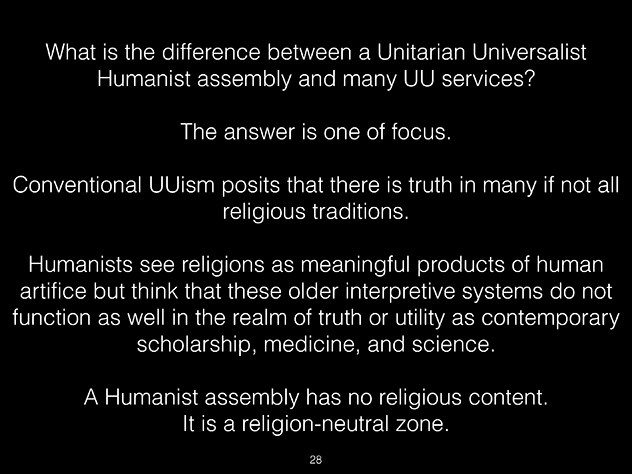
How does a Humanist assembly differ from a traditional UU service?
The answer is one of focus. Conventional UUism posits that there is truth in many if not all religious traditions.
Humanists see religions as meaningful products of human artifice but think that these older interpretive systems do not function as well in the realm of truth or utility as contemporary scholarships, medicine, and science. (Religions are also rowboats in the woods.)
After that, the rest is details: such as reaching out with programming in places other than our building.
And using our building for purposes other than only Sunday morning gatherings.
In other words, if you find yourself with a rowboat in the woods, find some people to help you carry it out . . . don’t be asking those single parents to support a building they didn’t build and that they seldom have time or energy to come to.
We offer some of our space free of charge to help out other non-profits that have missions aligned with ours,
such as
the Minnesota state advocacy network, Minnesota UU Social Justice Alliance and
Religious Coalition for Reproductive Choice.
In addition, we partner with other groups that have missions that align with our own . . .
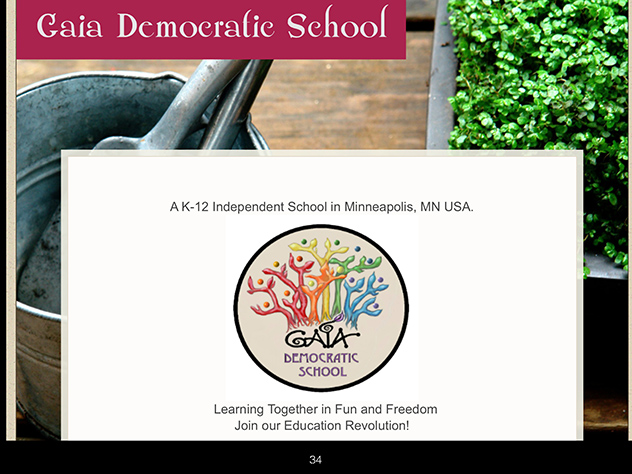
We house an experimental K-12 school. (They pay rent!)
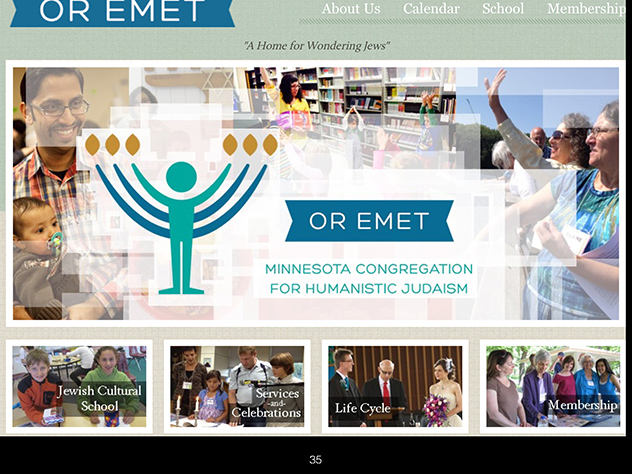
We host activities of our local Humanistic Jewish group . . .
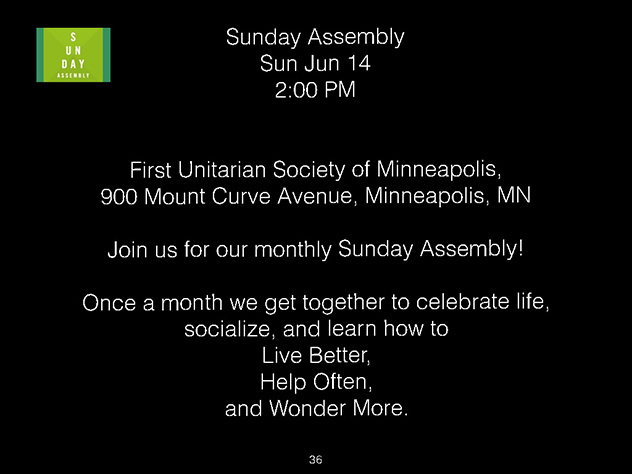
and Sunday Assemblies, the “atheist church” that has gotten a lot of press. We consider this our second service—and we don’t even have to plan it!
We also house a kirtan group—for Hindu chanting . . .
the Secular Buddhists . . .
some activities of the Minnesota Atheists . . .
and the Humanists of Minnesota.
I’m trying to get the “Secret Stoics of Minneapolis” to begin meeting in our building . . .
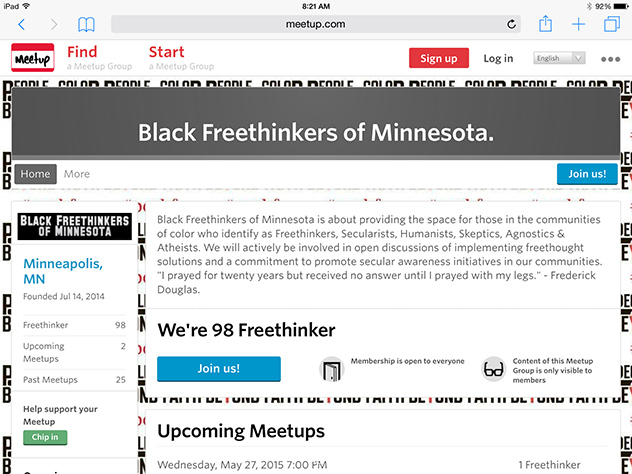
and we have been working with the Black Freethinkers of Minnesota on joint social justice projects.
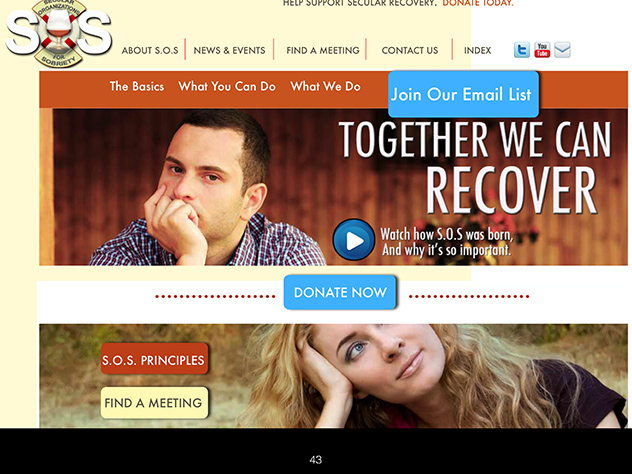
It’s a no-brainer that we host Secular Organizations for Sobriety,
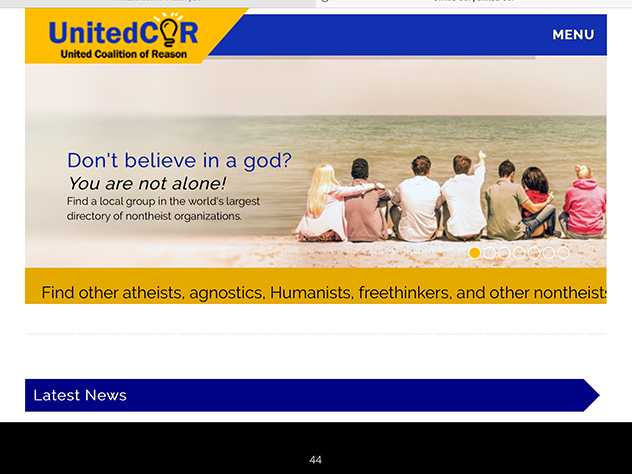
that we work with United Coalition of Reason—we will be housing the Minneapolis Chapter,
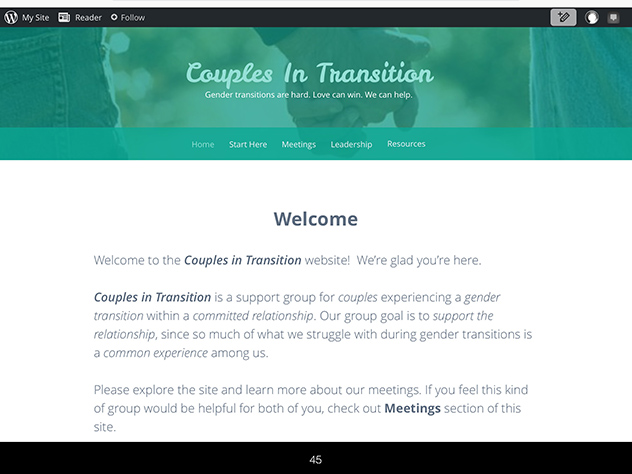
and Couples in Transition, a support group for couples facing gender transition.
All these are groups that are too small to own buildings, but they can pay rent and our building functions as a hub for liberal religious activity in downtown Minneapolis.
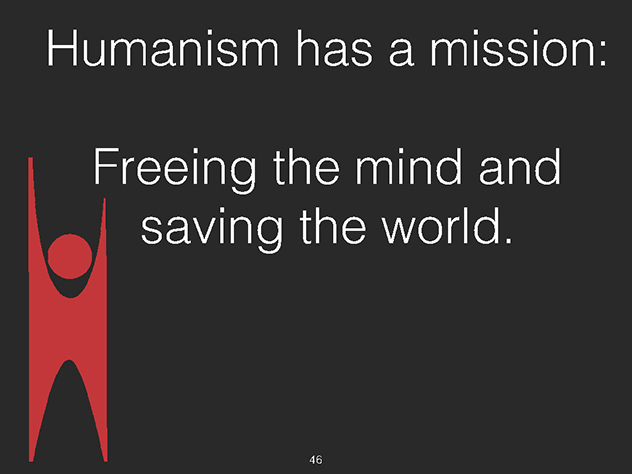
As the birthplace of congregational humanism in the Unitarian tradition, First Unitarian Society of Minneapolis has a mission; and all Humanists have that mission: freeing the mind and saving the world. Creating a community where no snake oil is sold . . .
The numbers are the numbers. Unitarian Universalists can scramble along with other liberal mainline denominations for the last remaining people who like to hear “god language,” or we can meet the needs of a small but expanding group of people . . . those done with religion but interested in free thinking; in community; in finding meaning and purpose; and in concerted, focused social action.
Sure, that very well may mean,
Unscrewing the locks from the doors!
and
Unscrewing the doors themselves from their jambs!
But . . . well that’s what Humanism is all about . . .
doing what it takes to free the human mind and save the world . . .
I laughed out loud yesterday when I got to the bottom of the stairs at the Oregon Convention Center for General Assembly and I saw the giant pendulum swinging in the foyer. Pendulums come up often when I'm discussing the place of humanism in the UUA with the people who come by the UU Humanists' booth in the exhibit hall. In the past, I'm told (since I am a new Unitarian Universalist and wasn't there to see for myself) the pendulum swung toward humanism, and now I'm told (and I see for myself) that it is swinging toward theism. The slow, relentless swing of the gold ball in the foyer is mesmerizing and the force must be tremendous, but I say it's time to stop the pendulum's swing entirely.
I just came from the Service of the Living Tradition celebration where the wonderful Marlin Lavanhar gave the sermon. Through the also wonderful power of YouTube, I feel like I know Marlin since I have watched him speak many times in the videos put up by All Souls Tulsa, where he is the senior minister. He also was one of our speakers last year for the UUHA GA program on how to create Sunday services that embrace the diversity of religious thought in our congregations. All Souls Tulsa has weekly services in three different styles to create the right nurturing environment for its humanist UUs, more traditionally religious UUs, and newly integrated Pentecostal UUs, while realizing that people don't fit into boxes and encouraging participation across and between.
The major message of the Service of the Living Tradition sermon was that we need to allow our people to be authentic and express their sincerely held beliefs. Yes, I said to myself as I applauded with the rest. This is only my third General Assembly, and I've gotten this message loud and clear many, many times in GA sessions and services. I've read this message in UU World, and UUA blogs, and on The VUU, the UUA/Church of the Larger Fellowship's on-line talk show. I've heard this message directly from senior UU staffers in Boston when we've met to talk about outreach to nontheists. Yes, we need to allow people to bring their authentic selves to their Unitarian Universalist community. Yes, feeling the need to hide part of your identity is being in the closet, and that is oppression.
Being a nontheist in America, I've used that analogy to LGBTQ experience many times. I've pointed to public opinion surveys that show that atheists are now the most distrusted minority, surpassing gays and lesbians, Muslims, and sometimes even rapists in polls. Fearing and hating atheists is irrational but it is socially acceptable. While I point out that this distrust does not generally result in the level of discrimination and oppression faced by many other minorities, it is still very real. This causes many, if not most atheists to hide their identity and stay in the closet. In some conservative parts of the country this is necessary to keep your job, your apartment, or sometimes even your family relationships. Think about that; sometimes people value their need for others to share their religious faith more than they value their relationship with their spouses or their children. Or put another way, sometimes people are so tribalistic and uncomfortable with difference that it can dissolve love itself, usually the most powerful force in human nature.
But wait! In Marlin's story and the UUA's story, I am the oppressor. I am his oppressor because he did not feel comfortable being open about his authentic self. What is wrong with Unitarian Universalism and what is holding us back from growth is our failure to embrace those who embrace God. Wow! I've heard second hand of ministers saying, "If we just wait for all those old humanist dinosaurs to die off, Unitarian Universalism will be free at last," but I never gave much credence to those stories or I dismissed them as the easily-ignored opinion of a small minority who are outside of the true spirit of UUA inclusivity. I know, with certainty, that Marlin Lavanhar does not feel that way, but yet I've heard both humanists and theists describe the other as "the problem" with the obvious implied solution.
When I discovered Unitarian Universalism after decades of being a "None", I was amazed and happy. It truly was amazing to this former Catholic -- a place where I could take my authentic self and my Humanist family and be loved and supported in ways that I thought were only available to theists or others who could accept the supernatural. I was indignant that I had lived so close to my current congregation for a decade but had been unaware that we would be welcomed there, to the extent that now I work for the UU Humanists trying to get other congregations to be better at communicating that welcome. Unitarian Universalist congregations are the only places in most parts of the country where that is true. But by celebrating that and seeking to broaden and communicate that, I am the problem with Unitarian Universalism!
UUA, where is the nurturing of my spirit? How do you help me deal with those fears that Marlin enumerated so well last night? I don't have belief in a higher power that is going to right the wrongs and wash away the pain using superpowers. I wish I did and I can fully understand why people do because life is hard for everyone, as the sermon pointed out. Grief touches everyone eventually, even the white, middle class, NPR-listening, privileged UUs. So, where are the GA sessions on Grief Beyond Belief? Where are the services that take their inspiration from our creation story, the universe story, and the truth that we are star stuff and part of a grand, magnificent, messy, wondrous, interconnected world? Where is the advice for what to tell my son when he can't sleep because he's afraid that he is going to die some day, or that I might die and leave him alone? Where is the training in UU seminaries of how to minister to people like me who need to rely on human hands and human love to find hope and purpose? Where is the sense of mission to reach out to people like me who have nowhere else to turn for solace and inspiration and community because we don't fit the religious norm? Where is the joy, and the celebration of life and love from a humanist perspective?
There are hundreds of thousands of Christian churches in America and plenty of other houses of worship for every imaginable form of religious thought. Some of them, like our friends at the United Church of Christ, are almost as liberal as we are and will welcome you even in your doubt or disbelief. They see the changes in society too and they know they need to broaden their perspective or fade into irrelevancy. They are making spaces without organs and pews, hymns and sermons, where people who do not respond to traditional religious forms and norms can still get their human needs met. We are not unique in embracing people where they are. But we are unique in embracing people where they are not, or at least we were.
There are new nontheistic "un-churches" springing up like wildflowers: Sunday Assemblies and Oases and Humanist Hubs that are joining the Ethical Societies and Humanistic Jewish communities that already dot the landscape. There is a new awakening in the secular movement that you need in-person community to become more fully human and to effectively serve the world. There's a hunger for experiences of celebration of life and ceremonies to add meaning to important life milestones in ways that used to be provided by religious institutions. The place that Unitarian Universalism used to play in the secular movement is being replaced by these new institutions because the UUA does not communicate that we want to be that anymore and when it tries, it does not do it well; it still feels like church. And when it doesn't feel like church it is too cerebral which makes modern nontheists still feel like they don't belong.
You are not serving my needs, UUA, by having the only two options be gospel or classical, speaking in tongues or reading a science journal, listening to a sermon or listening to NPR. Where is the nurturing of my spirit that is in my language of poetry and nature and human relation that isn't based on traditional religious words and symbols that have no meaning for me? Don't tell me that it is my issue or my millennial children's that we can't use God language metaphorically. That does not do it for me or for them. I resonate with Marlin's story of losing a child and how that universal, primal, human feeling of grief unites us across our mere differences in belief about natural vs. supernatural. But how do you help me deal with that when I can't turn to the solace of the hope that they may be "on the other side" where I might meet them again? Even most "believers" in our UU congregations remain at best agnostic about that possibility, so how do you help us deal with big questions when you know there are no absolute answers?
It is difficult to be all things to all people and our focus on Humanism and reason has, in the past, truly made theists feel they don't belong -- and that is not right. If embracing our religious, churchy side solves that problem and that is the problem you want to solve, then do it and do it well. If you wish to be the church for theists who are not necessarily Christians, then be that fully and stop blaming me and my fellow Humanists for keeping you in the closet. Better yet, and I don't mean this snarkily because I really love and admire them, merge with the United Church of Christ and broaden their liberal religious mission even further. Let theists breathe a sigh of relief and fully express themselves. But be honest about that and let me go find my community elsewhere. My authentic self is different from Marlin's authentic self. My authentic self says my creation story is the universe story; my authentic self says the only "super" power is love and it is not supernatural, it is woven through and embedded in human nature; my authentic self says embracing reality doesn't mean sacrificing meaning and beauty. But if the Unitarian Univeralist Association as an institution is not interested in developing the kinds of communities that meet the needs of people like me then clear the dance floor and let someone else dance. I promise to not step on your toes anymore.
Now, I could leave it at that because that seems like a good concluding paragraph, but that would be wrong because it reads like an ultimatum and the fact is that humanism and humanists are too fully embedded in the DNA of Unitarian Universalism to have us step away. And Unitarian Universalism is not just the UUA institution, it is an association of congregations full of people in relationship with one another across their diversity, with a deep sense of shared ownership and shared history. And we are not going away. The ones that have not already left are the flexible ones or the ones with deep roots. One solution to the problem of fully meeting the needs of a diverse group of people is modeled by Marlin himself and his All Souls Unitarian Church Tulsa: make space for one another. Don't try to be all things to all people all the time. Be open, honest, and respectful about our differences and don't try to do away with them or ignore them. Engage with our diversity and try new ways to serve those diverse people.
The UUA is focused on "Finding a New Way" (beyond that just being the theme of this year's GA) and experimenting with new models. Unitarian Universalism's uniqueness is no longer just its non-creedalism which is being adopted as the next step beyond nondenominationalism by many liberal religions. Unitarian Universalism's true uniqueness is in its longstanding embrace of nontheism. But our old ways of expressing that are no longer effective; we don't just want additional services where the God language is crossed out and replaced with fuzzier religious language. We want the UUA to recruit and encourage humanist ministers. We want them to train all religious professionals, including ministers, religious educators, and musicians, to consider the needs of nontheists. We want them to partner with us in thinking more creatively about in-person groups and on-line associations that can be spaces for humanists (and theists) to be our authentic selves. We want GA programs, outreach programs like CLF and others to sincerely reach out to nontheists and try to meet their needs, not convert them to our ways. The UU Humanist Association is too small and too outside the spheres of influence in the UUA to be the only engine of movement in the direction of authentic humanist community. We can't halt the swing of the pendulum ourselves and we are wasting too much of our energy trying to do so. The pendulum really needs to stop swinging. Read more about UUA, Why Aren't You Nurturing My Spirit? »
The UU Humanist Association is proud to stand with the AHA and our other Secular Coalition for America partners as signers of this letter to all members of the U.S. House of Representatives encouraging them to support the resolution to oppose blasphemy laws.
---
June 24, 2015
Rep. Ralph Abraham
417 Cannon House Office Building
Washington, DC 20515-1805
Dear Representative Abraham,
The undersigned secularist, humanist, nontheist, atheist, and religious freedom advocacy organizations write in support of H. Res. 290, a bi-partisan international religious freedom resolution recently introduced by Reps. Joseph Pitts (R-PA) and Sheila Jackson Lee (D-TX).
This resolution calls upon the President and the U.S. State Department to make the repeal of blasphemy laws a priority in their relationships with countries that have such laws. In addition, this resolution encourages the President and the State Department to oppose any efforts at the United Nations or other international forum to create an international anti-blasphemy norm, or attempts to expand the international norm on incitement to include blasphemy or defamation of religions.
Blasphemy laws are the most explicit laws banning the expression of doubts or criticism regarding religion, and various countries employ them to ban criticism of religious beliefs, symbols, and figures. In several countries, the penalty for violating these laws is as severe as death. These laws harm not just the non-religious, but dissidents in all religious sects.
Alexander Aan, a former Indonesian civil servant who in January 2012 posted messages to Facebook expressing his lack of belief in a god, was attacked at his workplace by an angry mob. When police arrived, they arrested Aan and charged him with blasphemy, promoting atheism, and disseminating information aimed at inciting religious hatred or hostility. On June 15, 2012, a district court found Aan guilty of the charges and sentenced him to 30 months in prison, and fined him an amount equivalent to $10,600.
Raif Badawi, an advocate for freedom of religion, belief, and expression, was arrested and charged on June 17, 2012 with insulting Islam and blasphemy. On July 29, 2013, a criminal court sentenced Badawi to seven years in jail and 600 lashes. On May 7, 2014, a Saudi court issued a new sentence for Raif: 10 years in prison, 1,000 lashes, and a fine equivalent to $267,000. On January 9, 2015, Saudi authorities gave Badawi the first 50 of his 1,000 lashes, and in June 2015 Saudi Arabia's Supreme Court upheld the sentence of 1,000 lashes and ten years in prison.
These are just some of the many cases of individuals who have been affected by blasphemy laws. Thankfully, Congress has the unique ability to promote international religious freedom on the global stage and to encourage governments of countries where religious and non-religious rights are not respected to remedy the situation. As such, the undersigned groups urge you to co-sponsor this important resolution, and support its passage should it come to the House floor or a committee on which you serve.
Sincerely,
American Atheists American Humanist Association Atheist Alliance International Atheist Alliance of America Camp Quest Center for Freethought Equality Center for Inquiry Ex-Muslims of North America Freethought Society Military Association of Atheists and Freethinkers Secular Coalition for America Secular Student Alliance Secular Woman Society for Humanistic Judaism Unitarian Universalist Humanist Association United Coalition of Reason Read more about The UUHA Joins a Coalition Urging Congress to Support Efforts to Repeal Blasphemy Laws Worldwide »
General Assembly is Our Chance to Gather, Learn, and Celebrate
GA is almost upon us! We are looking forward to
an excellent and informative UU Humanist program, Friday, June 26, 4:15pm, Oregon Ballroom 201,
a great celebration of Rev. Dr. Kendyl Gibbons at our annual meeting, Friday, June 26, 6:15pm, Oregon Ballroom 201,
and our usual large booth presence in the exhibit hall, Booth #201.
But the best thing about GA is getting to meet friends in person and to celebrate Humanism in Unitarian Universalism together. If you are going to be at GA, drop by the exhibit hall booth and connect and save the times for our events. We're looking forward to meeting many of you! Read more about Join the UU Humanists at UUA General Assembly 2015 »
Over breakfast this morning, my husband told me about an interesting NY Times article that I should read, "It mentions your UU Humanist organization," he added. I was skeptical, but I thought perhaps I had missed something since I had been busy all day yesterday at a memorial for a cousin and hadn't even glanced at social media. After a quick scan of my Facebook news feed, I concluded he meant this article, "Wanted: A Theology of Atheism", by Molly Worthen. After reading it, I could see why he thought that it had something to do with UU Humanism. Worthen writes, "Humanist fellowships have often imitated the practices of traditional worship. Sunday Assembly’s close relative, the Society for Ethical Culture, has featured rousing music and a lecture at Sunday meetings since 1876." When one encounters the phrase "Humanist fellowships", free association usually causes the phrase "Unitarian Universalism" to come to mind to the initiated.
And of course it does. There are over 1,000 well-established UU congregations to the Ethical Culture's 22 and Sunday Assembly's brand new 100-ish (if you include the ones listed as "warm-up" as well as "established")*. A good percentage of UUs are Humanists. How many you ask? We don't know for sure. It was 46% back in 1998, the last time the Unitarian Universalist Association actually asked. It is probably lower now but it is still quite high. Why is UU Humanism not even mentioned in an article about atheists building communities that are like religious communities? We make up the largest number of this group but we are often invisible to the press and to the public.
The first, obvious answer is that we are neither fish nor fowl. Because we are not 100% non-theistic, we are not even considered in the category of "atheist churches" that the media is so enamored with. This is even though the numbers of the openly secular in our churches / fellowships / societies / congregations dwarfs those of the other organizations and even though a significant percentage of our "clergy" identify as atheist, agnostic, and/or humanist. Some people see our inclusiveness as a bug and other people see it as a feature. Personally, I think our shared (humanist) values are more important than our lack of shared beliefs, and I value our UU resources and our long history of social action that increases our ability to change the world.
The second, obvious answer is because we don't tell people. How are they supposed to know outside of our circles? "We", the UU Humanist Association, obviously tell people that UU congregations are good "Habitats for Humanism", but "we" Unitarian Universalists individuals, congregations, and the Association that represents us don't often tell people. We keep our lamp under a bushel basket, to misappropriate an analogy.
Our architecture doesn't tell people we are not like other religious organizations, at least not in my neck of the New England woods. Almost all of the buildings look like typical Protestant churches.
Our congregations' names don't tell people; about half of the UUA congregations have the word "Church" in their name. Around here, another half have "First Parish" as well.
Our congregations' websites don't always tell people. Many of them mention we have no fixed creed and they link to the UUA's Principles and Sources, but they omit the positive statement that atheists and agnostics are welcome here. I know, I have done the Google search "atheist site:http://www.somechurch.org" on dozens of UU congregations' websites.
Our ministers don't always tell people. I tell the story that my husband and I were married by a UU minister as a compromise to please my religious family; one of my siblings told me, "Find a Unitarian. They'll marry anybody." What I didn't know at the time, and the minister, who performed a wonderful, personalized ceremony, didn't mention, was that my atheist husband and I would be welcome in his congregation. Mostly likely he assumed we would just know this.
Our national Association does tell people on the national website if you click around the Beliefs & Principles section. And to their credit, they have reached out for feedback and are willing to make changes to make their outreach more visible and inclusive.
So, there is little pull for atheists into UU congregations except for the tired but true joke, "What do you call an atheist with kids? A Unitarian." (Guess how I finally got connected with my local First Parish Church?) Once those kids are too old for Religious Education though, few stick around.
The idea of church for atheists has really caught the media's attention. The trend in our society is toward secularism so this interest and the need for secular community will only grow, just look at the rate that new Sunday Assemblies are starting up. Just as being a Welcoming Congregation for LGBTQ people does not mean a UU congregation is unwelcoming to straight people, being welcoming to atheists, agnostics, humanists and other non-theists (who share a similar problem with the LGBTQ movement of choosing an identity label) does not mean a UU congregation is hostile to theists. We need to tell people loud and clear, "Many of us are atheists and the rest stand on the side of love with atheists, in spite of our society's misconceptions about them." We can do this as individuals (ministers or lay people), we can do this as congregations, and we can do this as the UUA.
* After re-reading what I wrote about UUA, AEU and SA numbers, I do not want to leave the impression that this is a competition. One of the best scenarios I know of is having a Sunday Assembly meet in a UU space after the "traditional" UU service to give some non-theists an experience that feels more authentic. Or an equally good scenario is to have a UU congregation that is dual-affiliated with the UUA and AEU, like the Washington Ethical Society, thereby getting the best of both of those worlds. And there may even be other good choices in a particular area, like a local Oasis or Humanist Hub. What works best depends on the community of people involved, and cooperation and collaboration will benefit all by making more styles of community available so no one group has to be "one size fits all".
What is The Humanist Institute and why should you consider applyinging to join the new class, starting in August? As they say on the website, "Find out what you don’t know about Humanism". Here is more detail:
The Humanist Institute offers a Certificate in Humanist Studies. Students are enrolled in a small class (a maximum of 15 people) convening for eight sessions over two and half years. Classes meet in March, August and November. Prior to and in-between sessions, students prepare for class sessions through independent distance study and online discussion guided by the Assistant Dean and faculty.
Year One
The Humanist Institute does allow individuals to take just one year of it’s graduate-level program. This option allows students to gain an understanding of the Humanist life stance, values, and principles as well as Humanism in relation to others.
As our movement grows, we need more people with the skills needed to advocate for Humanism and become community leaders. Now may be the time for you to take on the challenge. Read more about Apply Now to The Humanist Institute »
It's always interesting to hear an outside perspective on Unitarian Universalism. Seth Andrews, host of The Thinking Atheist podcast, did a podcast called The Unitarians, on March 3. (You can pick it up at 7:15 if you're only interested in the actual topic.)
Seth interviewed UUHA board member David Breeden, minister at First Unitarian Society of Minneapolis, as well as Mike Werner, author of "Regaining Balance: The Evolution of the UUA", a book published by the UU Humanists, and others.
Have you ever felt like you go through the motions every day but it all seems meaningless? Did you know that you can use science to help you find a sense of life purpose? Wait, but science can’t answer life’s big questions – that’s the job of religion, right? Well, a wave of recent research in psychology, cognitive neuroscience, and other disciplines has explored how we find meaning and purpose in life, with or without belief in a deity!
I wish I knew that when I was growing up. I struggled with gaining a sense of life meaning and purpose throughout my teenage years and young adulthood. I remember experiencing the sense of meaninglessness as an emptiness deep in the pit of my stomach.
This sense of life purpose is not a trivial matter. Recent research shows that people who feel that their life has meaning experience a substantially higher sense of wellbeing and even physical health. For example, Michael F. Steger, a psychologist and Director of the Laboratory for the Study of Meaning and Quality of Life at Colorado State University, found that many people gain a great deal of psychological benefit from understanding what their lives are about and how they fit within the world around them. His research demonstrates that people who have a sense of life meaning and purpose feel in general more happy as well as more satisfied on a daily level, and also feel less depressed, anxious, and are less likely to engage in risky behaviors.
According to faith-based perspectives, the meaning and purpose of life is to be found only in God. An example of a prominent recent religious thinker is Karl Barth, one of the most important Protestant thinkers of modern times. In his The Epistle to the Romans (1933), he calls modern people’s attention to God in Christ, where the true meaning and purpose of life must be found. Another example is The Purpose Driven Life (2002), a popular book written by Rick Warren, a Christian megachurch leader.
But some thinkers disagree with the notion that religion is the only way to find meaning and purpose in life. Jean-Paul Sartre, in his Existentialism and Human Emotions (1957), advances the notions of “existentialism,” the philosophical perspective that all meaning and purpose originates from the individual. Another prominent thinker is Greg Epstein. In his Good Without God: What a Billion Nonreligious People Do Believe (2009), he advocates striving for dignity as a means of finding “meaning to life beyond God.” Likewise, Sam Harris, in his book, Waking Up: A Guide to Spirituality Without Religion (2014), states that “Separating spirituality from religion is a perfectly reasonable thing to do. It is to assert two important truths simultaneously: Our world is riven by dangerous religious doctrines that all educated people should condemn, and yet there is more to understanding the human condition than science and secular culture generally admit”.
Are they correct? Can we have meaning and purpose, which fall within the sphere that Harris refers to as spirituality and Epstein terms dignity, without belief in a deity?
So what does research on this issue show? Apparently, the important thing is simply to gain a sense of life purpose and meaning: the source of the purpose itself is not so important. Religion can be one among many channels to help someone gain a sense of life meaning. The pioneer in this field, Victor Frankl, was a Viennese psychiatrist who lived through the Holocaust concentration camps. In his research and work, both in the camps and afterward in private practice, he found that the crucial thing for individuals surviving and thriving in life is to develop a personal sense of purpose and meaning, what he terms the “will-to-meaning.” There are many paths to do so. For example, Frankl helped people find purpose and meaning in life through helping others to remember their joys, sorrows, sacrifices, and blessings, and thereby bring to mind the meaningfulness of their lives as already lived. Frankl’s approach to psychotherapy came to be called logotherapy, and forms part of a broader therapeutic practice known as existential psychotherapy. This philosophically-informed therapy stems from the notion that internal tensions and conflicts stem from one’s confrontation with the challenges of the nature of life itself, and relate back to the notions brought up by Sartre and other existentialist philosophers.
These findings fit well with my own research on secular societies. My desire to find a personal sense of meaning and purpose impelled me to pursue higher education and study how people in the Soviet Union, where my family came from, found purpose, happiness, and fun in life. The Soviet Union is typically perceived as a militaristic and grey society, with a government that oriented all of its efforts to taking over the world. Well, that’s simply not true, as the Soviet authorities put a lot of resources into providing its citizens with opportunities to find meaning and purpose in life, as well as fun and pleasure – although they also certainly wanted to spread communism throughout the world, and put a lot of efforts into this goal as well. To understand how the USSR’s government helped its citizens gain a greater sense of meaning and purpose, I spent over a decade investigating government reports in archives across the Soviet Union, exploring national and local newspapers, reading memoirs and diaries, and interviewing over fifty former Soviet citizens. The answer: to a large extent, through government-sponsored community and cultural centers called kluby (clubs). These venues, and other ones such as discos, offered Soviet citizens social and community connections, chances for serving others, and places to reflect on meaning and purpose in life, the three crucial factors that research shows help us gain a personal sense of life purpose.
Present-day societies with a more secular orientation than the United States have similar stories to tell, as illustrated by research on contemporary Denmark and Sweden. Most Danes and Swedes do not worship any god. At the same time these countries score at the very top of the “happiness index,” have very low crime and corruption rates, great educational systems, strong economies, well-supported arts, free health care, and egalitarian social policies. They have a wide variety of strong social institutions that provide community connections, opportunities for serving others, and other benefits that religion provides in the United States.
So where does this leave us? Religion is only one among many ways of developing a personal sense of life meaning and greater sense of personal agency. Based on my research, I presented a workshop at my local UU Humanist group, and had it videotaped for anyone who wants to learn more on this topic. I also developed a free online course, which combines a narrative style, academic research, and stories from people’s everyday lives with exercises to help you discover your own sense of life purpose and meaning from a science-based, humanist-informed perspective. These are part of our broader offerings at Intentional Insights, which aims to help us, as reason-oriented people, use scientific evidence to live better lives and achieve our goals. I hope you can find our offerings helpful for your life! Read more about A Humanist Take on Meaning and Purpose »



 FFPresentation.pdf Read more about Introducing the Freethinker Friendly Program »