Posts by Roger Brewin

Submissions Sought: Humanist Elevator Speeches
We humanists love to talk and explain (and then sum up, before adding footnotes!) …but brevity can sometimes be better. The Journal of Religious Humanism challenges you to be creatively brief. If you were asked, upon entering an elevator: “Hey, what is Humanism, anyway?” And you had to reply before exiting, what would you say?

In one floor? A dozen words or fewer? Example: “Wonder, imagination, fulfillment, creativity, meaning: available to everyone – religious or not.” Marilyn Westfall

In four floors? No more than 50 words? Example: “Humanism tells me human life is … worthy of respect and care. Environmentalism tells me: to be human is to be part of an interdependent circle of all life. Environmental Humanism compels me to … reduce human practices that threaten the survival of life on earth.” Carol Hepokoski

In twelve floors? 100 words, tops?

Secular Humanism. Religious Humanism. Plain ole’ humanism. Whatever you call it – tell us and our members/subscribers what it means to you. Pick one of the elevator-ride durations, and submit your positive description by April 30, along with your name, phone number, connection to Humanism and/or UUism, other relevant biographical information, and brief details of what inspires your vision.

We’ll publish as many entries as we can, but reserve the right to edit, with your permission. We’re not looking for perfect definitions of Humanism – just your unique take on what makes your humanism work for you. Perfection is rare and takes too long. We would love to include your positive description in our next issue.

We accept diamonds in the rough. Think fast, write just a little slower, revise sparingly, and send it in. Who knows? You could make us proud and we might make you famous (within a limited Freethinking universe).

Submissions and Questions to: Roger Brewin at Rabrewin@aol.com or 773-551-8540.


Roger Brewin, UUHA Journal Editor

  Read more about Submissions Sought: Humanist Elevator Speeches »

Categories: 

Dedication of “Ribbons Not Walls” display at Brevard UU Church, April 2, 2017

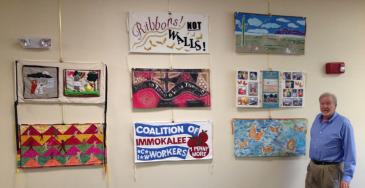
“Ribbons” consists of twenty four fabric art panels from over 40 artists around the country. Some are based on themes or cover art from books by Hispanic authors; others directly represent aspects of the immigrant experience.  “Ribbons” was displayed at the UUA General Assemblies in Louisville, KY (2013), Providence, RI (2014), Portland, OR (2015) and Columbus, OH (2016).  In between, panels have traveled to over 60 venues (UU congregations, Humanist meetings, art galleries, etc), and have been viewed by over 14,000 people.  More than 200 individuals (mostly UUs and humanists) have been involved in the  fabrication, curation, display and financial sponsorship of the exhibit.

Following four years on the road, and the wear and tear of being repeatedly set up and taken down, “Ribbons” is transitioning to permanent sites around the country.  These four panels are now on display at the Brevard UU Church, 2185 Meadowlane Ave, West Melbourne, FL  32904: 

Ribbons! Not Walls!                                                  

Artist:  Barbara Kurtz, Friendship Fellowship (UU),  Rockledge, FL
Theme:  The living connections that make us one world, one people.
Medium: Silk clothing remnants.


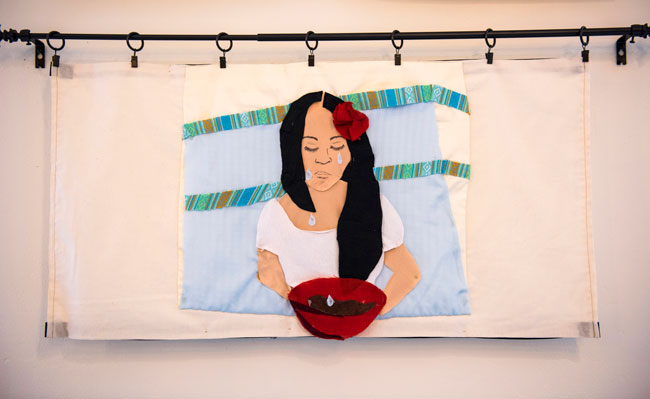
Like Water for Chocolate

Artist: Nicole Smith, Art Major, Alfred University, NY.
Theme:  Laura Esquival’s novel about Tita, a woman whose emotions impact others through her food.
Medium: Fabric collage and ink drawing.


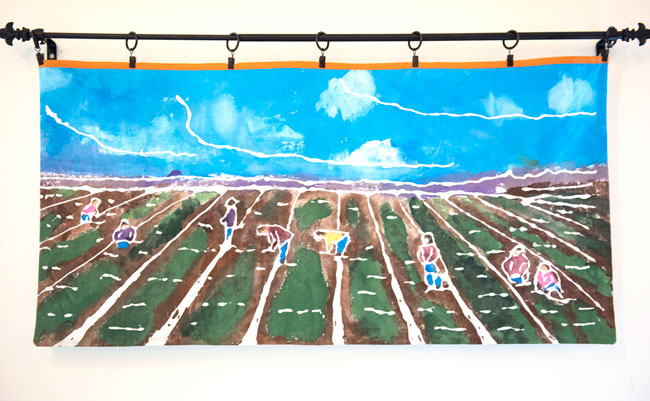
Migrant Field Workers
Artists:  Navigators USA chapter (ages 5-14) at Countryside Church, UU, Palatine, IL.
heme:  Harsh working conditions and low pay put affordable food on our tables.
Medium:  “kid-friendly” batik process with washable glue and permanent acrylic paint.


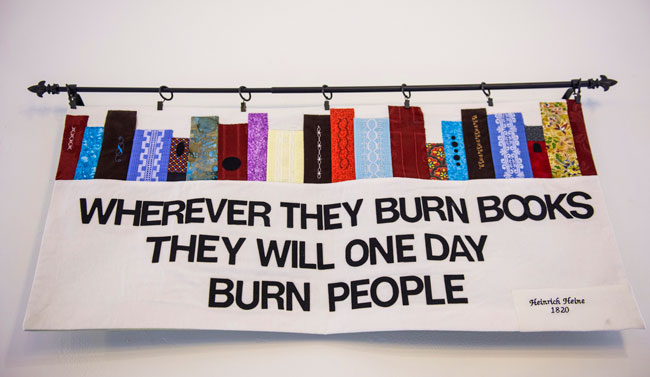
Burning …
Artist:  Rev. Kendyl Gibbons, All Souls UU Church, Kansas City, MO.
Theme:  Anonymous volumes honor those who have suffered for what they have written.
Medium: Piece work quilting.    

Ribbons Not Walls is sponsored by the Unitarian Universalist Humanist Association.   It was inspired by another UUHA social justice project, “Banned Books by Hispanic Authors,” which collected over 400 copies of books removed from Tucson classrooms when Arizona outlawed the teaching of “Ethnic Studies” in public Schools. These were displayed at the UU General Assembly in Phoenix in 2012, then donated to Puente, a local community organizing group.  Similar local libraries were established at Hispanic Community Centers in Louisville, Tucson and El Paso.

Ribbons Not Walls is curated by Roger and Katherine Brewin, 10559 S Wood St.  Chicago, IL 60643.   Contact them at 773 551 8540 or rabrewin@aol.com.  Thanks to Jim Morison for this installation.

Unitarian Universalist Humanist Association


The letter to UU Church of Brevard:


Ted Hicks, President
Unitarian Universalist Church of Brevard
2185 Meadowlane Avenue
Melbourne, FL 32904

April 2, 2017

Dear Ted:

On behalf of the Board and staff of the UU Humanist Association, we are pleased to transfer custody of four fabric art panels from the UUHA immigration project, Ribbons Not Walls, to the UU Church of Brevard for permanent display. 

These works by artists Kendyl Gibbons, Barbara Kurtz, Nicole Smith and the UU youth of the Navigator Scouts chapter in Palatine, IL are part of a larger collection that has utilized art to carry a message of welcome and inclusion to audiences around the country.  We are delighted that they will now help welcome members and visitors alike to UUCB,  and will remind all who enjoy them here, of the highest values of both Humanism and Unitarian Universalism.     

Si, Se Puede,

Roger and Katherine Brewin, Curators

Ribbons Not Walls,  UU Humanist Association Read more about Dedication of “Ribbons Not Walls” display at Brevard UU Church, April 2, 2017 »

Categories: 

Call for Papers on Naturalism

Submissions on the subject of "Naturalism" are sought by UU Humanists for the Spring, 2016 issue of the Journal of Religious Humanism, to be mailed to UU Humanist Association members and subscribers in May, and distributed at the 2016 UUA General Assembly in Columbus, OH., in June.  Opinion pieces or short essays should be in the 800-1500 word range; a 3,000 word limit and a request for footnotes apply to longer articles of a more scholarly nature. Those submitting sermons are asked to convert to a suitable form for print publication, including citations, and the removal of protected text, such as complete hymn lyrics. Writers may submit completed pieces for consideration, or receive a preliminary decision on publication by sending an abstract.

The distribution of this issue will coincide with the presentation of the 2016 Religious Humanist of the Year award to Connie Barlow and Michael Dowd, at the UU Humanists' Annual Meeting at the GA in Columbus. The editor seeks a wide range of views on the subjects of Naturalism, Religious Naturalism, and their relationship to Humanism and UUism.  The audience for this publication is primarily members and friends of UUHA, UU ministers and seminarians, lay members of UU congregations, humanist identified prisoners, and users of the library periodical collections at over 100 institutions of higher education. We anticipate additional copies will be made available to other individuals and groups with an interest in Naturalism.

The Journal of Religious Humanism has a print run of between 1,400 and 2,000 copies, with a small but growing electronic audience. We seek one time publication rights in print and by electronic distribution (by email and on our website), including the right to republish certain offerings in later issues as "Heritage Documents."  We do not ask for exclusive rights, and you are free to seek and accept other publication offers for the same material.  Our general policy is to grant requests from others to reproduce for publication and other uses, subject only to appropriate credit to the Journal and the author;  we make every effort to secure the writer's permission in each case.  

The Journal does not offer payment for articles published. We do supply each author with six* free copies of the issue containing their article, and a two year subscription to the Journal.  

We hope you'll consider a submission, and help celebrate the work of Connie, Michael and the UU Humanists, supporting science, nature and humanism.  

Proposed articles should be submitted as an email attachment, preferably in .rtf format to the Editor at Rabrewin@aol.com. no later than March 1, 2016. 

Abstracts (limited to 250 words) should be submitted in the body of an email, to the Editor at rabrewin@aol.com.  Abstracts submitted before January 15, 2016, will receive a response on that date. Subsequent abstracts will be responded to on a rolling basis.

Roger Brewin, Editor
Journal of Religious Humanism
773 551 8540

*Additional copies upon request - a small shipping fee may apply. Read more about Call for Papers on Naturalism »

Categories: 

The Fall 2015 Issue of the Journal: The Threading the Interfaith/Interpath Needle

The Fall 2015 issue of the Journal of Religious Humanism has now been delivered to active members' mailboxes and/or Inboxes.

Humanism is so often described as being in opposition to, or at best in a creative tension with religion, that the path of interfaith cooperation can seem highly problematic, and perhaps more trouble than it is worth. Yet increasingly, individuals and Humanist groups join with their religious counterparts on specific social justice and service projects, and simply to further the goal of living side by side, even if in an uneasy peace. The fall 2015 issue of the Journal of Religious Humanism explores these efforts from several points of view - from the humanist organizations that have embraced particular events and coalitions, to individuals of many persuasions who have struggled with what it means to work and celebrate with those whose basic perspective on life is very different.

There are eleven articles ranging from short reports on humanist participation in Washington's 9/11 Unity Walk, and the World Parliament of Religions, to a fairly lengthy series of commentaries by UU ministers of many stripes wrestling with the resources that get used when Interim Ministers from many traditions undergo training together. Writing about "God-Centered Atheists,"  "Lessons for Humanists from 'Night Vale'" (a mystical radio drama), and a "Year of Interfaith Service," our authors give personal accounts of the interfaith experience, some as full blown participants and enthusiasts, and some as part-time experimenters. Read more about The Fall 2015 Issue of the Journal: The Threading the Interfaith/Interpath Needle »

Categories: 

Humanist Oasis in the GA Exhibit Hall

Booth 416

Drink deep from the latest books by our own Humanist Press authors and other Humanist writers; dive into a pool of nationwide social justice opportunities - immigration reform and opposition to censorship; quench your thirst for updates on cooperative projects on leadership training and humanist community. 

All this and the latest info on local Humanist groups and programs in the UU universe; engagement with representatives of local and regional secular organizations; the latest copy of the Journal of Religious Humanism and a collection of freethought wit and wisdom on stickers, pins and magnets.

Plus the chance to meet and greet HUU Board members and booth volunteers - experts tell us they are the liveliest folks at the General Assembly!

Stop by - refresh yourself, ask a question, give your opinion, renew your membership, get a UU Humanist namebadge ribbon to show your Humanist pride, peruse the displays, purchase a pin-on, stick-on slogan or some more substantial reading, make a new commitment to humanist values, make a new friend, make your day at GA!

Some say it will be worth the trip to Providence just to stop by the HUUmanists booth; some say you sense a deep and resonant pulsing there that is the heartbeat of UUism; some say you can't have more fun with your clothes on; all we know is - it's all good, but it won't be perfect till you get there.  See you at the booth?

  Read more about Humanist Oasis in the GA Exhibit Hall »

Categories: 

"Ribbons Not Walls" Social Justice Project Update

The fabric arts/social justice project that began prior to last year's GA, and was featured at the HUUmanists booth in Louisville, began its second spring tour in April. Two dozen panels on various immigration themes have been shown in seven venues over the winter including three midwest UU fellowships, a minister's study group and and a Democratic party dinner. Recent and upcoming presentations in three humanist groups in Michigan and Kentucky, Regional and District UU Meetings in Bloomington and Vero Beach, and three UU congregations, including a month long show in the gallery of Thomas Jefferson UU Church in Louisville.   

The twenty five panels, made by over 40 humanist and UU artists around the country (ranging in age from 13 to 94) cover a wide spectrum of immigration related issues, and showcase half a dozen styles from traditional quilting to batik.  The newest additions are commemorative panels containing the names of the previously anonymous Braceros who died in the 1948 Los Gatos plane crash, made famous by the Woody Guthrie song, "Deportee."  These plus all of the original pieces will be part of the HUUmanists booth at GA 2014 in Providence, RI.  Included this year will be a parade of all the artwork throughout the convention center, by fifth through eighth grade children participating in the GA camp on identity and oppression.

Please contact Roger Brewin (773 881 4028, 773 551 8540 rabrewin@aol.com) or at the HUU booth at GA if you are 

a)  a congregation or group with an interest in immigration reform who wish to arrange a future showing of or programs about the art work, 

b) an artist who works in fabric media who wishes to submit an idea for additional panels;

c) an individual or group wishing to sponsor a panel. 

  Read more about "Ribbons Not Walls" Social Justice Project Update »

Categories: 

HUUmanists Continue the Fight Against Classroom Censorship

Since shorthly after the State of Arizona outlawed Public School courses in "Ethnic Studies," and removed some 80 books, mostly by Hispanic authors, from Tucson classrooms, HUUmanists has been involved with opposing these acts of censorship and cultural oppression.  Partnering with Puente (a community organizing group in Phoenix) and "Librotrafficante" Tony Diaz of Nuestra Palabra, we had well over 300 people each "smUUggle" one of these banned books into the UUA's 2012 General assembly in Phoenix.  

Over the next year we helped establish community libraries based on banned books at Puente's new headquarters, and in Tucson, El Paso and Louisville.  This year we are giving individuals the opportunity to "spread banned books around:" buying a low cost copy of one of the titles, and after reading it, passing it on to a friend, or dropping it in a public location.  Labels on the cover and fly leaf of each book explain why it was "banned," and how the reader can participate. 

So far we have placed in libraries or public locations over 700 copies of the books Arizona did not want students to read.  You can help get us to a thousand!  Pick up a copy at the HUUmanist booth at the Providence GA in June, or at HUU tables at UU District meetings in Erie, PA, Bloomington, IN or Vero Beach, FL, his spring.

You can keep the project going by donating in any amount (we'll buy more banned books) at HUUmanists.org.  Just note in he comments section that your donation is for Banned Books.  Let Roger Brewin know at 773 881 4028 or rabrewin@aol.com if you'd like to get your humanist group or congregation involved. Read more about HUUmanists Continue the Fight Against Classroom Censorship »

Categories: 

I prefer religious language - no snark! Well, almost none.

[Editor's note: this is a response to David Breeden's Sneaking One Over on the Humanists post and the religious language poll.]

That's right I'm one of the ten percent of respondents in the poll who expressed a preference for religious language - not because I use it a lot, but because it is useful to me in a much wider universe, than is "non-theistic" language alone.  I do use a lot of non-religious language too - in the meetings and on the advisory board of the large Midwestern Secular community (CFI Michigan) to which I belong. And much of the time, in the UU congregation (Berrien UU Fellowship - about half humanist in membership) in which I am active. And in the overwhelming majority of my dealings with HUUmanists.  

But when I deliver a sermon to that congregation, (also half non-humanist) as I do in retirement a couple of times a year, at the invitation of the current minister, or when I preach "on the road," usually about UU Humanism and its various projects, I use some, not a lot, of "religious language."  As I do when I converse with my colleagues, retired and active in the UU ministry, and when I talk to congregational and UUA leadership.  I don't use religious language exclusively in these settings, but neither do I hobble myself socially or intellectually by a stubborn refusal to admit that the words exist, and have great meaning to others, many of whom I would like to cooperate with in a variety of endeavors. 

My point is that it is not a simplistic choice between using one vocabulary or another.  I'm perfectly capable of talking about "faith" to one UU, and "commitment" to another, or using both terms in the same paragraph to a "mixed" audience.   I can talk at length about "spirituality" in a UU context, and never use the word at all in a humanist context. I can talk about science as the way of knowing (and making predictions about) the material world, and I can talk quite comfortably and successfully about "God" to someone whose religious stance (UU or more traditional) includes a belief in God, though I have been an atheist since childhood.   

I didn't pick choice # 3 in the survey: "I don't have a problem with it (religious language).  I can translate the words to have non-theistic meanings." I didn't pick it  because I don't need to make religious language go away by translating it.  It has its uses, even to one who, like me, does not accept the supernaturalism behind much of it.  Note that I say "behind," it. There's nothing inherently supernatural about the concept of human spirituality - and spare me the bleat that it contains the word "spirit."  There's nothing logically impossible about holding a God concept that is totally natural.  I know some of you are already typing away about how "almost everybody" hears those terms and thinks supernaturalism, and how we mislead when we use words outside of their commonly accepted meanings. I will give you my response in advance - might save us both some aggravation:  

In forty plus years of UU, humanist and interfaith interactions, I've never had a common project for social justice, for service to those in need, or for just plain human community, fall apart because someone misunderstood my use of language.  Never had someone say "we can't feed the hungry together because when you occasionally say "sacred" you don't seem to mean what we all mean by it;  never had someone decline to lobby a congressperson with me because either our beliefs or the language we use to describe them, are different; never been told that "we can't break bread together" and have fun together because we hold to different metaphysical schemes for the significance of bread-breaking and hospitality.  

Have I had people refuse to work with me on "interfaith" projects?  Yes, but they were the folks who also wouldn't work with the Baha'is and the Hindus and the Buddhists in town, and in some cases not even with the Catholics and Jews. I stopped worrying about what they thought about my choice of language long ago. In fact, if my occasional humanistic use of religious language confuses them, so much the better.  And frankly, I've stopped worrying about what many of you, my fellow humanists think about my and others' occasional use of religious language.  To the roughly half of you who simply don't like it much, or are even made to feel unwelcome by it, I say - we've got too much to do to spend time and energy on this. If you don't like it when I occasionally say "faith" or spirituality", well - translate it, if you must, and please otherwise just ignore it.  I'll try to find some other kind of welcoming flag to wave. 

I don't use religious language a lot, and when I do, I certainly don't use it to turn away or upset my fellow humanists. I don't demand that you must use it in return.  And if I see you wince, I'll dial it back in our particular conversation. Deal? Read more about I prefer religious language - no snark! Well, almost none. »

Categories: 

Big, Bad Booth?

I've been "running" the HUU booth at General Assembly, with an able assist from Jack Reich and each year, a rotating cast of enthusiastic others, since 2002.  I take some pride in the fact that we are usually among the largest and most energetic displays in the exhibit hall.  I take pride in the fact that we share our space with other humanist and social justice organizations - this year the Channing-Murray Campus Ministry, the Humanist Institute, Secular Student Alliance, and a Gun Control group called "Change the Conversation," were all on board.

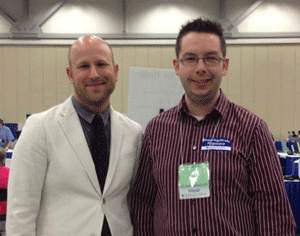
Greg Epstein of Harvard Humanists and Kevin Watson of The Humanist Institute

To me, our prominence among exhibitors reflects some of the best of UU humanism:  the fact that we believe enough in our values and programs to promote them with vigor; the fact that we are reminding our fellow religionists, gently, that UUism runs on humanist values, from the language of the Purposes and Principles, to the emphasis on individual conscience in religious matters, that is at the heart of many UU congregations, to our Association wide penchant for social justice action.  The  connections with other groups also speaks to me: the Humanist Institute is not only a major part of training the next generation of humanist leaders, it is also an incubator for educational materials for all those call humanism home; both the Secular Students and UU campus ministries are at the forefront of creating humanist communities for a new generation.


Jessica Kirsner of Secular Student Alliance
Two years ago the HUUmanists board began cautiously endorsing social justice projects, in response to the call for a Justice GA.  The focus on censorship in the Arizona Banned Books project appealed to a broad humanist consensus - even though it was clear that our national membership held divergent views on the policies in question.  The focus on literature and the right to read, and the creating of alternative libraries based on the infamous eighty Tucson volumes, in Phoenix, in El Paso and in Louisville, created a common front. The invitation issued to fabric artists, to add their vision with the "Ribbon" project, an effort in which emotion lead reason to some extent, was also adopted only after considerable reflection.  We didn't want to simply slap the organization's approval on something, and then regret it later.  

So when Janet Fisk (backed by a UU social justice staffer) asked this past spring if our June 2012 booth could host her "Changing the Conversation" program on Gun Control, I didn't know if we would have enough time for the kind of careful deliberation we had previously given such decisions.  I needn't have worried: Janet's reasoned approach of aiming to involve gun rights as well as gun control advocates in the same broad ranging conversation, and her use of the arts (she is a documentary film maker) an area of social action with which we had become familiar, was a combination that carried the day.  Sensing the social urgncy of the issue, and the need for a variety of activist approaches under our HUU rubric of "reason and compassion," our board said: "if there is any other issue we should be adding to our agenda this year, this is it."


Janet Fisk, filmmaker

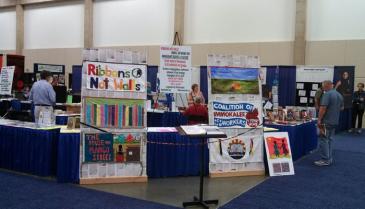
Janet's films and fliers joined a booth already adorned with the two dozen "Ribbons Not Walls" art pieces, and 160 copies (two full sets) of the Banned Books, headed to the library of the Americana Center, which serves 17 immigrant groups in Louisville.  

Arguably, the biggest, baddest thing at the booth this year was the sizable contingent of HUU Board members and regional volunteers who helped staff it.  They engaged folks who came by (I estimate about 2,500 of the 3,500 or so GA attendees visited our location) answered questions, handed out literature, sold books, stickers, pins, memberships and sponsorships for our social justice programs. Others have done the same in years  past, but in much smaller numbers.  Combined with our increasingly productive board meetings, livelier web presence and growing publication and social justice profile, this years HUU booth effort gives me great hope.

Come see us in Providence - June 2014.

Roger Brewin, booth coordinator Read more about Big, Bad Booth? »

Categories: 

Ribbons on the Road

A collection of two dozen fabric arts panels made by humanist and UU artists around the country, began its fall tour during the last weekend of September, with a showing at a Michigan community event and a UU Fellowship Sunday service.  "Ribbons Not Walls" (a project of HUUmanists) invites people to create yard long representations of immigration related events and themes.  The collection includes a starkly poetic rendering of a portion of the "wall" between the US and Mexico by 13 year old Illinois UU Alayna Vesto, two panels featuring the primitive quilting style of Linda Lee, lead artist of the well known Farmworkers Memorial quilt out of Florida, and the HUUmanists "Librotraficante" (Book SmUUggler) Iogo, stitched and be-ribboned by Michigan secular humanist Sherron Collins.  

"Ribbons" began as an outgrowth of the Banned Books project run by HUUmanists for the 2012 UU General Assembly in Phoenix (the "Justice GA."). Initially artists depicted themes from some of the 80 books, mostly by Hispanic authors, that were removed from Tucson classrooms when Arizona lawmakers voted to end "Ethnic Studies" in that state's schools. (See RibbonsNotWalls.org or the facebook page ribbonsnotwalls for more information on the Banned Books project.)   Gradually the art project widened to include impressions from congregational events about immigrant rights and culture, and then to individual and group reflections on the impact of the issue on our society. 

As panels came in through the spring of 2012, they were put on display singly and in small groups at more than a dozen humanist meetings, UU congregation and district conferences. The first full installation of all the panels was at the HUUmanists booth (see "Big, Bad Booth" article elsewhere in this issue) at the June 2012 GA in Louisville, where it was seen by over two thousand attendees.  Subsequently the minister and members of Berrien UU Fellowship in St. Joseph, MI arranged for the full collection to be on display September 28 at the Berrien County Unity Fest, an annual political event held this year in a huge 19th century barn.  The Ribbon panels were stretched from the rafters, above the heads of 150 diners and dancers. The next morning at BUUF's Sunday morning service, led by Roger Brewin, self-styled "curator" of the project, the panels were held aoft by congregants, then formed a visual backdrop for the post service discussion.

The next stop for the Ribbons tour will be Northern Hills UU Fellowship just outside Cincinnati, with a service by Brewin on the morning of October 27, followed by a public showing throughout the afternoon.  UU ministers in the Ohio River (study) Group will get a look at the panels (and a chance to contribute to the collection) on Wednesday evening November 13 in Dayton, Ohio.  Further showings at art galleries and on seminary campuses are being negotiated.  Humanist groups and UU congregations that would like like to host the art work in 2014 are invited to contact Brewin at Rabrewin@aol.com,  773 881 4028 or 773 551 8540.

"Ribbons began as a way to let artists shine a different spotlight on the issue of censorship, and the right of every culture to define itself without interference," says Brewin - "these are aspects of the broader immigration question that appeal particularly to humanists.  The Ribbons art does not demand that you take a particular political stance on immigration, or that you follow a particular set of actions.  It does demand that you encounter the people and communities involved, through the honest filter of your own emotional reactions and rational convictions. The art both brings you closer to people, and gives you a medium through which to put aside reactivity, and encounter their humanity.  As a humanist, I have "faith" that that sort of encounter can change things."  Read more about Ribbons on the Road »

Categories: 

Pages