July 2015

Spiritual But Not . . . Keep Talking, Humanists

Literary critic Terry Eagleton said, “The din of conversation is as much meaning as we shall ever have.” I like that. On first glance, it appears to be bleak—human conversation is all the meaning there is?

But imagine what human conversation has given us.

Imagine the din of conversation under the porches (stoa) and under the trees (akademeia) in Athens during the time of Socrates.

Imagine the din of conversation in Baghdad in the late 700s when an institution called the  House of Wisdom opened it’s doors—an attempt to gather all the wisdom in the world. 

Think of the din of conversation in Florence that led to the Renaissance. The din of conversation in Shakespeare’s London. The din of conversation in cafes that created the Vienna Circle at the beginning of the Twentieth Century.

The din of conversation in the Paris of the 1920s. Or Greenwich Village. Or North Beach in San Francisco in the 1950s that gave rise to the Beat Generation.

Think of the din of conversation in Liverpool, England that led to the Beatles. Or the din of conversation in a little recording studio called Sub Pop that led to the Seattle Sound, better known as Grunge.

Too often we think of lonely geniuses but genius is seldom lonely. Shakespeare and his Globe theatre were not the only show in town. Shakespeare’s London had twenty-seven public theatre venues. The Beatles weren’t alone. More than fifty British bands made up the so-called British Invasion.

Looked at from this perspective, from the view of what gets created in the crucible of human sharing, Eagleton’s phrase does not sound quite so bleak: “The din of conversation is as much meaning as we shall ever have.” Why ever would we want more than human conversation?

Would we really want a voice from on high coming to proclaim the once and final truth? Isn’t the mystery more beautiful, the stabs in the dark of the millions of human beings who have taken part in this great din of conversation, this lovely human project of creating meaning?

I believe in community. A place where people talk with each other. In coffee houses. In bars. In streets and market squares—public spaces and the din of conversation—this is the meaning of meaning. And it is why totalitarian regimes fear the public square and it is why religions burn books.

The term “conversation” originally meant “intimacy with others.” It also meant “sexual intercourse.” Only later did the term take on its present meaning of talking.

Let’s just say there’s something intimate about conversation.

What if the increasing din of human conversation, and its increasing complexity, is the hope of humankind? Would it be so bad if the talking that led to the Renaissance and a band called Nirvana is all the heaven we humans shall ever know?

Let’s take one conversation as an example. Two human beings, Michael Murphy (not the pop singer) and Frederic Spiegelberg, started a conversation. They agreed that the human spiritual impulse need not necessarily follow any one religious tradition. They thought that people could be “spiritual but not religious.” That phrase is a cliche now, a whipping boy for various dogmas. But in its day the phrase was a radical new thought. Spiegelberg published a book titled The Religion of No Religion.

The two men founded an institution called the Esalen Institute. Now, whatever you may think of what the Esalen Institute became, look at how pervasive a conversation between two people back in the 1950s has become. “Spiritual but not religious” as a concept is destroying traditional religions in the United States.  And Murphy and Spiegelberg would not be upset by that. The Esalen motto is “No one captures the flag.” No religion has all the truth. And science doesn’t either.

Aren’t gratitude and grace and compassion and love and astonishment part of human nature? Part of our evolution? How could any one religion steal the flag of wonder or awe? As a matter of fact, how do any of these things have anything at all to do with religion?

Isn’t gratitude and grace and compassion and love and astonishment just as available in art, in music, in poetry? Available to each of us somewhere in the din of conversation?

Isn’t science a conversation too? A conversation that is less dependent upon cultural assumptions. A conversation in many languages.

Eagleton is correct: “The din of conversation is as much meaning as we shall ever have.” That din includes the Beatles. And Moses and Mohammed and . . . you and me.

Keep the conversation going. It’s all we have. It’s all we’ve ever had. It is enough.


Image credit: Benjamin Luig, by Heinrich-Böll-Stiftung on flickr, licenced under Creative Commons Attribution-ShareAlike 2.0 Generic. Read more about Spiritual But Not . . . Keep Talking, Humanists »

Categories: 

Book review: Christianity without God, by Daniel C. Maguire

Christianity without God: Moving beyond the Dogmas and Retrieving the Epic Moral Narrative, by Daniel C. Maguire. SUNY Press, 2014, 226 pp, $24.95.

 a review by Edd Doerr

 “In these pages,” Dan Maguire  writes as he begins this important book, “I argue against the existence of a personal god, the divinity of Jesus, and the belief that continued living is the sequel to death. I find no persuasive arguments for any of these hypotheses,” these assumed foundations of Christianity. “What would be refreshing,” he adds, “is a moratorium on god-talk so that together we could explore alternatives to earth’s current social, political, economic, and ecological distress.”

Maguire, Professor of Ethics at (Jesuit) Marquette University and a former priest, is a longtime supporter of women’s rights regarding contraception, abortion and overpopulation. (See my review of his book, Sacred Choices, in Voice of Reason No. 80 in 2002 at arlinc.org.) In this brisk new book, brimming with humor and common sense, Maguire eviscerates the myths and supernaturalism of the Bible and traditional Christian theology but says that there are gems of wisdom and ethics to be found in those sources, though, one cannot help but note, those gems are buried under mountains of muck that require a patient, careful geologist like Maguire to unearth. The book reminds one of the Jefferson Bible or Bernard Shaw’s quip that as his followers did not understand Jesus’ religion, they made him the religion.

Maguire pokes fun at the Vatican’s “pelvic zone orthodoxy” and highlights the importance of dealing with climate change and its concomitants: “deforestation and  habitat destruction, soil erosion and salinization, water management problems, overhunting, overfishing, foreign species affecting native species, human population growth, and increased per capita impact of people,” a litany similar to the one I have long been chanting.  He concludes: “No deity will come to save this gifted and generous earth. It’s a challenge for humans not for gods. . . . The hour is late; some damage is irremediable. But it is not too late to start reversals.”

Further: “We are a spoiled species that seems hell-bent on wrecking the earth that cradles us and we are well on in that demonic suicidal project. It is an alluring temptation for the likes of us to imagine a superbeing with parental passions who is both omnipotent and all merciful who will make everything right ‘on earth as it is in heaven’. Such delusions are typical of adolescence. And adolescent is what we are.”

Maguire’s humanism shines brightly through in this terrific book, though he does not use that term. And it bears out what I wrote in this haiku: “Labels may conceal / far more than they may reveal / they can mask what’s real.” Read more about Book review: Christianity without God, by Daniel C. Maguire »

Categories: 

The Naturalism Discussion: Moving Beyond the Humanist / Theist Debate

People are more important than beliefs.* Some may consider this a corollary to the first Unitarian Universalist principle, “The inherent worth and dignity of every person”, or the third, “Acceptance of one another and encouragement to spiritual growth in our congregations [and beyond].” We are Unitarian Universalists because we choose to be in community with one another. So, let me rephrase that slightly: relationships are more important than beliefs.

I've published a few essays recently about my perception of the place of humanism in the Unitarian Universalist Association. Many of the comment threads on those essays and on Facebook have been enlightening, and engaging with my fellow UUs in all of them has been a privilege. The essays also prompted at least one response in another blog. I realize now that I made some unexplained assumptions in those essays and that others have made assumptions about me and about humanists in general so that we are sometimes talking past one another. The summary of this recent engagement and reflection on it leads to the thesis of this post: Unitarian Universalism is moving beyond the humanist/theist debates and is transitioning to a discussion about naturalism.

First, indulge me while I get a little analytical. Not all humanists are analytical by nature, in spite of what some may think, but I admit to being guilty as charged. (Note that I say that jokingly just in case it is hard to tell in this medium. Some humanists have a sense of humor too!)

One of the assumptions I have been making that may be wrong is that we are using the same definitions of humanist, theist, atheist, agnostic, and naturalist. Before I get into this, I do have to apologize to those who are uncomfortable with labels. I agree that labeling is often a barrier to understanding because it sets up false circles around people that include or exclude, but I maintain that it is OK to self-identify based on your worldview while keeping in mind that we are all UUs and that relationships are more important than belief. As we tell our coming of age young people, it is fine work to clarify your worldview and to be able to express it clearly, as in a credo.

In this essay, I’m going to define a humanist as a naturalist who has a particular interest in ethics and human and societal flourishing. Yes, being a naturalist means our worldview is without gods, which is the definition of atheism (“without theism”, not “against theism”) so I am going to use the word atheist even though many UU humanists do not self-identify as atheists. Just to make everyone potentially equally annoyed, I’m going to contrast naturalist with supernaturalist, and use the latter to refer to someone who believes in any entities, forces, or experiences that are outside of nature. Then I’m going to substitute the word theist even though I know there are many examples of supernatural beliefs (like animism, karma, and panentheism) that don’t require or imply belief in a personal God or gods. I’m going to try to avoid using secular/religious entirely though I observe that the wider culture commonly uses them as replacements for both atheist/theist and naturalist/supernaturalist.

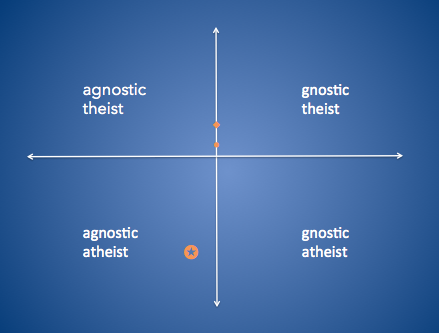
I observe that there’s an atheist / theist scale representing how strong your belief is that there is no meaningful god concept up to your belief in a very traditional, Western concept of a personal God (or gods) who rules over the universe, can perform miracles, and intervenes in the affairs of people. Similarly, I’m going to propose, or more accurately share and modify what other people propose, that there is an orthogonal agnostic / gnostic scale that reflects how firmly you feel you know your position is true. An agnostic does not claim to be certain, a gnostic does feel certain. If you put the two scales together, you get a graph like the following:

belief-knowledge space

It’s my observation that most UUs fall on the agnostic side (we fall to the left, what a surprise!) There are certainly gnostics in our community, both atheists and theists, but being open minded is the norm and the expectation. I also need to point out the obvious that a person’s point is not fixed over time. Some trace a path that covers a large distance on this graph and others just oscillate around a point. One person’s location may move slowly (or never move at all) and another’s might shift quickly, which is often traumatic and disorienting. There is also not necessarily any right or wrong direction on this graph unless you consider “towards my position” as right and any other direction as wrong. (Many people disagree strongly with me on this point, I know, and I enjoy listening to their reasoning. For me, the only part of the graph I have a problem with is the extreme right edge, particularly the top.) Finally, it’s useful to note that some people’s point is fuzzy because they don’t care enough about the question to decide where they stand; they are “apatheists” a portmanteau of “apathy” and “theist”, or just haven’t settled on a position. Others reject the whole model, Sherwin Wine called them “ignostics”, saying the question is not meaningful because “every theological position assumes too much about the concept of God”.

The difference between this graph and the ones in the references above is that they show binaries: you are either an atheist or a theist, you are either gnostic or agnostic. It’s an important part of my point that people are not binary; there is no black and white, there are scales of belief and confidence in knowledge. This means the star representing my position is in the agnostic side of atheism, but not too far from the (weak) gnostic side. I am fairly far from calling myself a theist. Even though I understand the reasoning of people who go just over the line and remain naturalists, I do not find it helpful to my "spiritual growth" to go in that direction (toward using theistic language to describe my naturalism). In fact, I have a problem with the term "spiritual growth" for this reason -- those who do use religious language think of spiritual growth as upward on this graph. As I said before, this is because it is natural to think of the "right" direction to move on this scale as toward your position. I would point out that many atheists consider theirs a more "mature" position, so moving down on the graph would be "spiritual growth" for them, though, being allergic to even quasi-religious language, they probably would not phrase it that way.

What I want to highlight on this graph is that the interesting point on the up-down axis isn’t the center, which divides self-identified atheists from self-identified theists. The interesting point to me is what I call the natural/supernatural point, which is up above the center (I've marked it with an orange dot). There are some UUs whose conception of divinity or “the sacred” is poorly described by the humanist (equated with atheist) / theist dichotomy. What puts them over the line is style – they find the language of theism more descriptive of or compatible with their position. (They prefer “night language”, to use Michael Dowd’s phrase.) If you ask them to describe what they mean by God or any other theistic concept, the response is naturalistic -- it is poetry that draws them above the line. They may describe themselves as pantheists. People on either extreme may try to use the “no true Scotsman” fallacy to push people off of their side, but this is a graph for self-identification. I’ll also note another important point further up the up-down axis: this is roughly the panentheist position (that I've maked with an orange triangle).

If we could have a scatter plot of UUs on this graph, I contend that a great majority of us would fall fairly low and to the left. Obviously, there is no UU circle or other shape on this graph that you are either inside of or outside of – that would require a creed – however, there is a center of gravity. Like an individual’s point, that center of gravity can and does shift. This is all just a thought experiment because I know of no scale that could be applied to these axes. Ultra-orthodox religions would cluster in the top right and New Atheists would be close to the bottom right (but probably not as close to the right, strong gnostic edge, because of the part of the scientific method about being willing to revise your beliefs based on strong evidence). I think there is widespread agreement that most UUs fall below the point on the theism scale where our values come from humanistic concerns, rather from a perceived need to please a God or gods or to avoid punishment in an afterlife.

Some of you are still uncomfortable with me pointing out these differences between us and question my motives. I want to point out that it is OK to criticize ideas but it’s not OK to criticize people. The Unitarians certainly had no problem with criticizing the idea of the trinity. The Universalists certainly had no problem with criticizing the idea of eternal punishment. As a humanist, I do criticize the idea of something beyond nature and I defend the idea that nature is enough, because nature includes complex human nature that encompasses imagination and deep emotions like love and compassion. It also includes other intangibles like hope and justice. Part of that human nature is defensiveness and I can understand how some who believe in something that transcends nature would interpret disagreement with that concept as criticizing them as people. I do not think it is important for all to believe as I do (that there are no forces, entities, or experiences outside of nature), but I do think it is important for others to understand why I believe it and to not disrespect or make assumptions about me because of it. (And my reason is very simple: I don’t see a need for anything else, never mind any indication.)

It came across in the comment threads that some theists act as if humanism only encompasses science and reason, not just that it values science and reason. I think it is true that some humanists overvalue science and reason; we call this scientism, and I criticize that idea as well. Conversely, it has come up that some UUs think (or perceive others as thinking) that any expression of theism, even the ones in the humanistic range, are ignorant and are a rejection of critical thinking. It was pointed out that I (and the UU Humanist Association) don’t criticize those stances publicly as often as I (we) should and I agree. While I do think there is an actual, important difference between naturalism and supernaturalism, there is no difference in human nature of people on either side of that point on the belief scale and we are all clustered so closely together on bigger issues that have actual moral implication, it is a shame to waste energy on debating. Rather than debate, I’d prefer to have a discussion with you about what experiences you have had or things that you value that make you believe in the supernatural. Or just hang out with you and drink coffee.

So, why do I write articles expressing disappointment about implied slights to UU humanism? I will write more about that later, but the simple answer is because otherwise you are going to lose me and people like me. You are also going to fail to attract a large segment of the population that has rejected traditional, organized religion but that is looking for community. The UU Humanist Association has a new program, the Freethinker Friendly congregations program, that I think will be helpful in making space for humanists in congregations in a way that enriches all. We all agree that this is not a zero sum game. It does require engagement and discussion, but I think we can all agree that we are past the need for an atheist / theist debate.

So I hope that the discussion so far has illustrated what I think is the common understanding among UUs that the humanist / theist distinction is a false dichotomy. I also hope it has helped situate UUs as clustered close together on the scale of atheism / theism in the wider culture and made the point that you can be a naturalist as both a humanist and a theist, and, more importantly, that you can adopt a humanistic ethic even while accepting some supernaturalist beliefs. And, though I didn’t make any arguments in its defense because I think it is obvious, let me restate my opening premise: relationships are more important than beliefs.

* This is a nod to the Oasis Network, a new model of humanist community. “People Are More Important than Beliefs” is their first value.

Pansy image credit: "Pansy aka" by André Karwath aka Aka - Own work. Licensed under CC BY-SA 2.5 via Wikimedia Commons. Why a pansy? Because they are the symbol of freethought and because it is pretty. Read more about The Naturalism Discussion: Moving Beyond the Humanist / Theist Debate »

Categories: 

Wrap-Up of the 2015 General Assembly in Portland, OR: Building a New Way

The 2015 UUA General Assembly is over now and we are finishing tallying up, following up, and evaluating how it went and what we will do differently next year. GA is always a fantastic time to connect with each other in person and to introduce the Association to a whole new group of UUs.

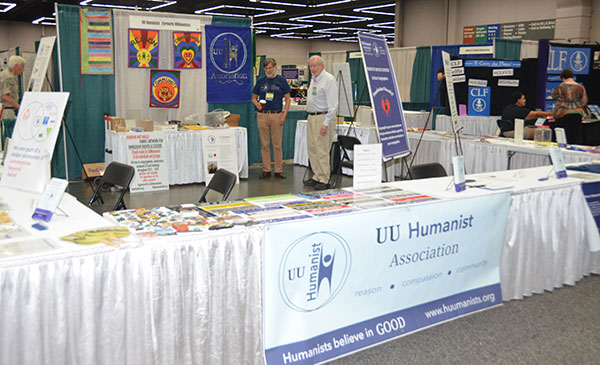
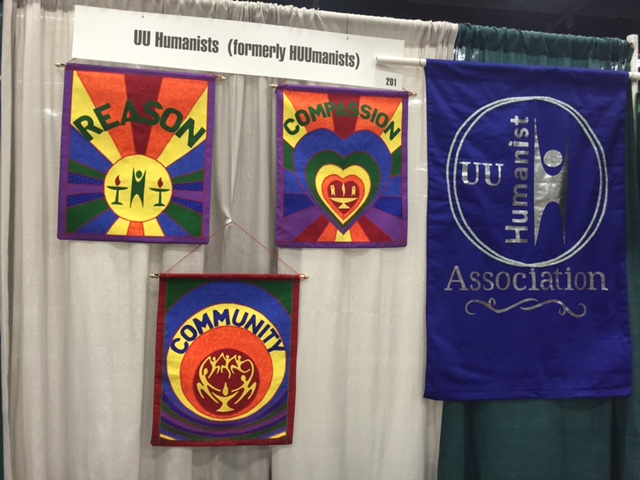
Our booth in the Exhibit Hall could not have been in a better location -- at the end of an aisle directly across from the entrance doors. As usual, Roger Brewin, in the light blue shirt in the picture below, did a yeoman's job planning, setting up, and later tearing down the booth. Click on the picture below for several more shots showing the different displays on the tables.

Featured in the booth were the usual "eye candy", as Roger calls it, which included bumper stickers, pins, and magnets as well as, new this year, rainbow-hued ties, stoles, and banners with humanist and UU symbols, donated to us by member and friend Rev. Jim McConnell. Given the fantastic news we received in the midst of GA about the Supreme Court ruling on same sex marriage, those were a big hit and sold out fast!

The booth also featured displays about the new Freethinker Friendly congregation program, the S.O.A.P. environmental justice project, various books (most from our own press) and our journal for sale, UU Humanist t-shirts, and a few panels from the Ribbons Not Walls immigration rights / banned books project featuring a panel made by our Religious Humanist of the Year award recipient, Kendyl Gibbons.

Over the course of the week, we signed up almost 100 new or renewing members, sold a lot of fun and provocative merchandise, and had hundreds of fascinating conversations with UUs about humanism in their lives and congregations.

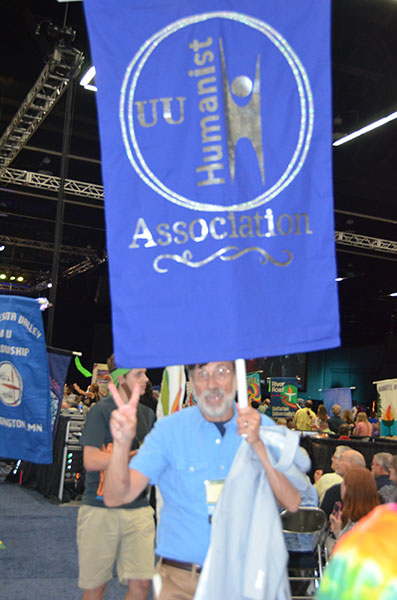
It was a banner year in another way -- we now have a banner! President John Hooper carried our banner in the parade during the Opening Celebration on the first day. We also displayed the banner in the booth all week and during our events.

On Friday, we came together for the program we arranged, "Serving the Nonreligious", then for our Annual Meeting and presentation of our yearly award. After the formal meeting, many of us hung around enjoying the refreshments and strategizing ways to involve more of the members from the west coast and how to work with related organizations.

While at GA we also attended many interesting programs, particularly in the Innovation and Growth topical track learning about developments like multisite and emerging ministries, and in the #blacklivesmatter and #commit2respond climate justice tracks. As usual, the worship services were inspiring but sometimes uncomfortable, at least for me. We encourage all who went to GA to use the GA Attendee Feedback survey to express their honest opinion. The Ware Lecture with Dr. Cornel West and the #blacklivesmatter demonstration were highlights, as was the spontaneous marriage equality celebration.

We owe a big thank you to all the board members who attended and helped out, to our members Warren Wylie, Chris Schriner, and Jack Reich who spent many hours in the booth, to our speakers David Breeden and Kevin Jagoe (both of whom are now on the board as well), and to the UU Community Church of Washington County that lent us a projector (and saved us several hundred dollars in rental fees).

We've started planning already for next year's GA in Columbus, OH. While we await details about the theme of GA '16, we've already decided to focus our outreach on Positive Humanism and to grapple with the interesting topic of Humanist "Spirituality". We look forward to continued engagement with the extended UU community! Read more about Wrap-Up of the 2015 General Assembly in Portland, OR: Building a New Way »

Categories: 

Kendyl Gibbons ~ 2015 Religious Humanist of the Year

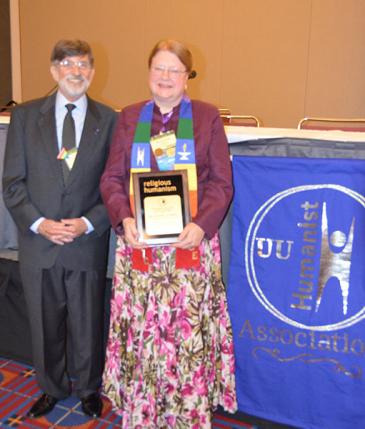
It was my pleasure to award Rev. Dr. Kendyl Gibbons the 2015 Religious Humanist of the Year Award at our Annual Meeting at General Assembly on June 25. Here is the introduction I gave to Kendyl, followed by her remarks. Congratulations again, Kendyl!


The Reverend Dr. Kendyl Gibbons is the 15th senior minister at All Souls Unitarian Universalist Church. She is a lifelong Unitarian Universalist, a recognized leader in our continental Association, and past president of the Unitarian Universalist Ministers Association. Kendyl is a 1976 graduate of the College of William and Mary, with BAs in Religion and Sociology. She holds a Master’s degree from the University of Chicago Divinity School, and a Doctorate of Ministry from our UU seminary, Meadville/Lombard Theological School.

Kendyl served as the minister of the DuPage Unitarian Universalist Church in Naperville, Illinois for fifteen years before being called to the First Unitarian Society of Minneapolis in 1998. In 2012 she was called as the senior minister at All Souls here in Kansas City.

Kendyl has a long-standing commitment to theological education and the future of ministry. She has formally supervised more than twenty student ministry internships, and been an informal teacher and mentor to dozens of seminarians. She has been an adjunct faculty member of the United Theological Seminary in the Twin Cities, and former Co-Dean and Mentor for the Humanist Institute. She currently teaches in the areas of worship and liturgy, and the dynamics of professional leadership, and serves as adjunct faculty at her alma mater, Meadville/Lombard Theological School in Chicago.

As an active member of the Minneapolis Downtown Interfaith Clergy group, Kendyl traveled to Jerusalem and Bethlehem with twelve Christian, Muslim, and Jewish colleagues in January of 2007. Among her Unitarian Universalist colleagues, she recently chaired the committee that revised the Ministers Association code of conduct and professional guidelines.

Kendyl has been widely published in UU journals and publications,  including Quest,Religious Humanism, and the UU World, and she has made numerous presentations at the annual UUA General Assemblies. She is a contributing author to Parenting Beyond Belief; On Raising Ethical, Caring Kids Without Religion. Kendyl has received the John Burton Wolf Prize for Excellence in Preaching, and the Meadville Lombard Alumni/ae Association Excellence in Ministry Award. She is also the author of two hymns included in the 1991 UU hymnbook, Singing  The Living Tradition, as well as “Sources; a Unitarian Universalist Cantata.”

She lives in Kansas City, east of Troost, with her husband of 40 years, Mark, and two cats.

Humanist of the Year Presentation

by Rev. Dr. Kendyl Gibbons

June 25, 2015


This recognition is a humbling honor, for which I am deeply grateful.

It occasions the following reflections on the purpose of ministry and religious community

in a context of theological pluralism.


For if what we are about is building connections --

among the various constituencies of the liberal tradition,

and in interfaith work more generally --

is not, and ought not to be,

the achievement any kind of theological uniformity,

then it is reasonable to ask, what is it that we are attempting to help each other do?


St. Paul offers one clue to this riddle, I find, with his list of the fruits of the spirit –

love, joy, peace, gentleness, forbearance, self-control.

If Christianity is doing its intended work in you, he suggests,

you will bear this kind of fruit, become this kind of person.

The Buddhist teaching tale of the Sanyassin who gives away a precious jewel

points to the same principle;

if the eight-fold path is working in your life, then you are growing into this kind of person.  

In fact, I would suggest that, despite their obvious differences

in vocabulary, mythology, and ritual practice,

the most profound mystics and teachers of all the world’s great religious traditions

have long recognized each other across their diverse heritages.

A spiritually mature Christian, a spiritually mature Buddhist,

a spiritually mature Muslim, or Hindu, or Confucian, or Humanist,

all have something in common -- a certain quality of personhood,

a way of being in the world, that manifests these fruits of the spirit.

This is more than a studied set of ethical exertions, or prescribed compassion;

rather it is natural, spontaneous, joyful;

a sense of presence that mediates profound reality unselfconsciously and without argument to others.

At our best, it is the foundation of mine and my colleagues’ credibility as religious leaders,

that we are spiritual grown ups,

whose example of maturity other people can rely on for guidance and help.


I believe that our congregations, and our culture, and our world,

all hunger for leaders who are spiritual grown ups –

who are more invested in becoming their own best selves

than enforcing their convictions or their authority on others.


One primary characteristic of spiritual maturity

is what the moral philosophers of ancient Greece called sophrosyne;

the self-awareness that enables us to maintain our ideals and intentions

even when passion or impulse or inertia or neediness --

or popular hysteria -- pulls hard in another direction.

The call to ‘know thyself’ constantly summons us out of naive embeddedness

in our perceptions and our environment,

to learn to take our impulses, our experience, and even our existence,

as objects of reflection, rather than inevitable facts.


Another evidence of spiritual maturity is the capacity to be in the presence of pain,

whether our own or others’, without panic.

Too often, the instinctive reaction of remedy

arises out of resistance to the reality of suffering;

we want to fix whatever is wrong immediately,for the sake of our own discomfort,

and if that is not possible, then there is a desire to flee from the situation.

To be a spiritual adult is to have the wisdom and fortitude

to remain in the presence of pain, while controlling our own anxiety and resistance,

so as to be of genuine help to those who are hurting.

Then we may be able to be skillful, rather than premature,

in alleviating the cause of the discomfort, or, if that is not possible,

at least bear witness to its truth through the eyes of compassion.

When an individual must move through the grief that comes with losing a loved one,

or when a community must undergo a difficult change,

immediate relief from heart ache is not always a helpful gift,

even if it were possible.

The spiritually grown up leader offers encouragement and validation,

rather than anodynes,

so that whatever learning or gift might lie on the other side of suffering may not be wasted.

Our task then is to help one another learn to face into

the truth of our own and others’ hurt,

and not to prefer frozen numbness, or self righteous judgement,

to the ache and effort of genuine healing.


I believe that the spiritually mature person also recognizes that all language,

even the most precise of mathematical formulas, consists of metaphor;

all speech and all writing relies on our ability to translate

from symbols to experience and back again,

and this is nowhere more true than in religious language.

We each give our primary loyalty to a particular vocabulary and symbol set,

to a tradition of inheritance or of choice;

this is as necessary for our fulfillment as human beings,

and indeed for our emergent spiritual maturity,

as the specificity of parental relationships and marriage commitments,

or the uniqueness of friendships.


Yet the person who is wise, who is a spiritual adult,

has the capacity to engage and appreciate the metaphors

by which other souls

also express the human religious impulse,

and narrate the breaking of a qualitatively different awareness into mundane consciousness.

Gratitude, generosity, the sense of being blessed beyond anything we have earned

amidst a grandeur that we did not create

and a potential for moral order to which we are inherently accountable –

this is not proprietary software specific to any one tradition,

but the open source code of human religious experience.

To be a spiritual grown up is to know reverence when we see it,

in any system, whether we ourselves prefer PCs or Macs.


As fluently as we hope to master the deep meanings of our own faith traditions and symbols,

may we also aspire to hear with understanding and appreciation

the poetry of the human spirit wherever it rises to aspiration and praise.

May we come to understand

that the striving to stay true to our values and alert to the sacred dimensions of life and reality

is not unique to any of us;

that to be present to suffering without panic,

and to move with confidence among the metaphors by which human experience is shared,

are skills we each continue to build as long as we live.


In the end, neither the demands of scholarship nor the disciplines of personal practice

will entirely satisfy this world’s need for spiritual adults;

certainly the squabbles of theological identity politics will never do so.


In an era when grandmothers at prayer are shot down by hate-crazed adolescents with guns,

we have something more important to do than trash each others’ metaphors;

we need to grow up, all of us, and get over the fantasy that the world would be a better place

if only everybody conformed to our opinions.


I suspect that in the end such maturity can only be nurtured in communities of faith --

by which I mean groups in which we are faithful;

to our commitments, and our values, and our aspirations.

And faithful as well to each other; not only in the present acceptance of who we are,

but also in the vulnerability of growth,

and in accountability to the promise of greater maturity that we might yet achieve.


While I confess that I have no other experience for comparison,

it has always seemed to me that Humanism is a demanding spiritual path,

precisely because it offers no alternative to the work of becoming grown ups;

to cultivating the self-awareness and skill that ought to make us particularly good

at weaving the strands of diversity

into the fabric of welcome and mutuality,

inviting everyone into a more profound community

that nurtures maturity in all of us,

and calls forth that more abundant life that we can only bring into being together. Read more about Kendyl Gibbons ~ 2015 Religious Humanist of the Year »

Categories: